Home » The South Bay Hardscaping Guide: Design, Permits & Soil Secrets
Get Your Free Estimate
Fill out the form below. We reply within 24 hours.
ON THIS PAGE
- Hardscaping
The South Bay Hardscaping Guide: Design, Permits & Soil Secrets
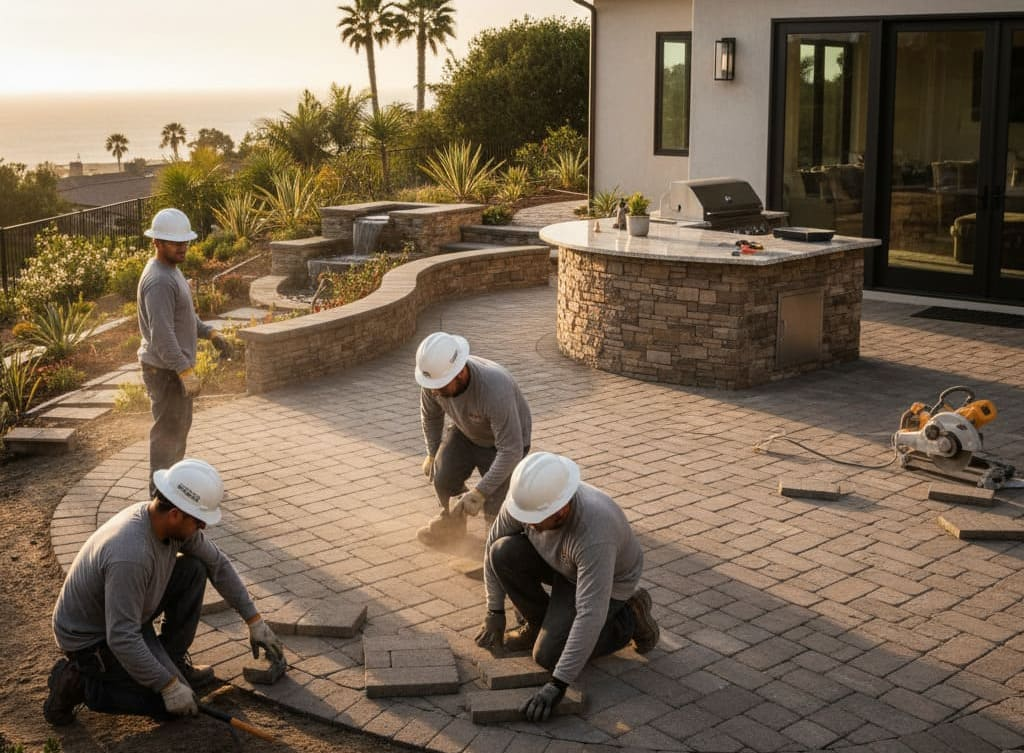
If you live in the South Bay, your backyard isn’t just a yard—it’s an extension of your living room. Whether you’re catching a breeze in Redondo Beach or managing a hillside view in Palos Verdes, we all share the same goal: Seamless indoor-outdoor living.
When planning a makeover, you’ll hear two terms: “landscaping” and “hardscaping.” Most of us know landscaping (the plants). But hardscaping is the “skeleton” of your yard—the patios, walkways, and walls that give the space structure.
A beautiful yard needs a balance of both. But here is the secret: The hardscape must come first. You can replant a rose bush easily, but moving a concrete patio or a retaining wall is a major construction project. It needs to be planned perfectly from day one.
Top 3 Hardscaping Trends in the South Bay
Living in our coastal environment influences design. Here is what we are building most often for local homeowners:
1. The "California Room" (Patio)
In beach cities like Manhattan and Hermosa where lot sizes are smaller, a well-designed patio often replaces the lawn entirely. We design covered patios with large sliding doors that blend seamlessly with the indoors, essentially adding a new room to your house.
2. Hillside Retaining Walls
If you live in the “Riviera” section of Torrance, San Pedro, or Palos Verdes, gravity is your enemy. Retaining walls are structural necessities that hold back soil to create flat, usable land on a slope. They turn a useless hill into a tiered garden or a flat patio.
3. Paver Driveways
Your driveway is often 30% of your home’s front visual. Replacing cracked asphalt with interlocking pavers is the single fastest way to boost curb appeal. Plus, pavers are flexible, making them ideal for our seismic area.
The "Hidden" Engineering: Why You Can’t Skimp
As a professional builder, the biggest mistake I see homeowners make is obsessing over the surface material (the pretty stone) and ignoring what goes underneath it.
You can buy the most expensive Italian porcelain pavers on the market, but if they are installed on a bad base, your patio will fail within two years.
[Image of cross section of paver installation]The South Bay Challenge: Sandy Soil
Much of the South Bay sits on sandy soil. While this is good for drainage, it can shift easily if not contained. When you hire a professional, you are paying for:
- Excavation: Digging out 8-10 inches of organic topsoil.
- Base Compaction: Installing a multi-layer base of crushed gravel and bedding sand, compacted with industrial machinery.
- Geo-Textile Fabric: A special fabric that prevents your gravel base from sinking down into the sand over time (crucial in Hermosa/Manhattan Beach).
Important: "Lot Coverage" & Zoning Rules
This is a specific issue for homeowners in Hermosa Beach, Manhattan Beach, and Redondo Beach.
Most cities have “Impermeable Surface” limits. For example, you might only be allowed to cover 50-60% of your lot with “hard” surfaces (house + patio + driveway). If you pave your entire backyard without a permit, the city can force you to tear it out.
The Pro Solution: We often use Permeable Pavers. These allow rainwater to soak through the joints and back into the ground. This often satisfies city codes and allows you to pave a larger area than you could with concrete.
How to Choose a Hardscaping Contractor
When you are ready to start, look for a contractor with a C-27 (Landscaping) or B (General Building) license. Ask them these three specific questions to test their knowledge:
- “How do you handle drainage?” (They should talk about positive slope, channel drains, or French drains).
- “How deep is the driveway base?” (For a driveway holding cars, it must be 8-12 inches. If they say 4 inches, show them the door).
- “Do you use polymer sand?” (The answer must be Yes. It locks pavers together and stops weeds/ants).
Conclusion: Build It Once, Build It Right
Good hardscaping is the foundation of a great lifestyle. Before you plant a single flower, you need a smart plan for the bones of your yard.
Ready to transform your property? Whether you need a simple paver patio in Lawndale or a complex hillside terrace in Palos Verdes Estates, GAGA US Construction has the local expertise to build it right. Contact us today for a consultation.
Frequently Asked Questions
Let's Build Something Lasting
Stop searching and start building. If you are ready to secure your home and boost your curb appeal, let’s talk. We are currently booking for the 2026 season.