Home » Commercial Silt Fence Installation and Erosion Control
Get Your Free Estimate
Fill out the form below. We reply within 24 hours.
ON THIS PAGE
- Fence Installation
Commercial Silt Fence Installation and Erosion Control
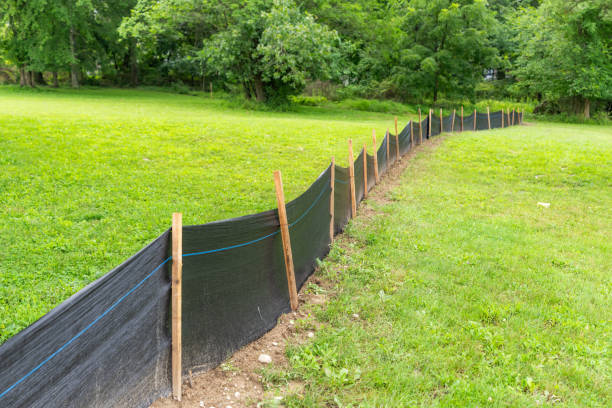
If you’re managing a commercial site in Los Angeles right now, you know the pressure is on. Between the push for new housing, the relentless expansion of the Metro lines, and the looming deadline of the 2028 Olympics, the city is practically vibrating with construction activity. But while everyone is focused on steel beams and concrete pours, there’s a much less glamorous component that can shut your entire operation down in a single afternoon: the humble silt fence.
It’s just black fabric on some sticks, right? Wrong.
In the current LA market, that black fabric is your primary insurance policy against five-figure fines and project-killing delays. The Los Angeles Regional Water Quality Control Board (LARWQCB) isn't messing around this cycle. They are aggressive, they are using satellite imagery, and they are handing out citations that would make a CFO weep.
The "Greenbook" vs. "Brown Book" Trap
If you’ve built anywhere in Southern California, you know the "Greenbook"—the Standard Specifications for Public Works Construction. It’s the bible for the region. You follow the Greenbook, you’re usually good. But Los Angeles has to be different.
The City of Los Angeles operates under the "Brown Book." These are specific amendments and additions to the Greenbook that apply strictly within city limits. This is where we see B2B contractors from Riverside or Orange County get hammered. They bid a job based on Greenbook specs, install standard silt fencing, and then fail inspection because they missed a Brown Book amendment regarding trench backfill or encroachment into the public right-of-way.
The B-Permit Factor
If your commercial project involves improving the street frontage—widening a lane, putting in new driveways, or touching the sidewalk—you are in "B-Permit" territory. This is managed by the Bureau of Engineering, and their inspectors are notoriously strict about sediment leaving the site.
You cannot just run a silt fence right up to the curb and call it a day. The Brown Book and LADBS codes generally prohibit placing erosion control devices in the street unless you have a specific override. This means your perimeter control has to be surgical. You often need to survey the exact property line and install your fence just inside it. If you build it six inches into the public sidewalk, you’ll be ripping it out and doing it again on your own dime.
Silt Fence SE-1: It’s an Engineered System
Let's strip away the jargon and look at the engineering reality. A silt fence (designated SE-1 in the CASQA handbook) is a hydraulic structure. It is a dam. Its job is to pool water, not just catch rocks.
When storm runoff hits your fence, it creates a pond. The water sits there, and gravity pulls the sediment particles down to the bottom. The "clean" water then slowly filters through the fabric. If the fabric is too porous, the mud goes right through. If it's too tight (like cheap plastic sheeting), the fence acts like a solid wall, the pressure builds up, and the whole thing blows out or knocks over your posts.
The Wire-Backed Standard
In Los Angeles commercial construction, "Standard Silt Fence" (just fabric on posts) is rarely enough, especially given our topography. You will almost always want—or be required to use—wire-backed silt fence.
This consists of a 14-gauge welded wire mesh grid attached to heavy-duty steel T-posts. The fabric is then clipped to this wire grid. Why do we spend the extra money on this? Because when an atmospheric river hits the LA basin and drops 3 inches of rain in 12 hours, the hydrostatic pressure against a fence at the bottom of a slope is immense.
The Installation Methods: Trenching vs. Static Slicing
There is a massive difference between a silt fence that works and one that looks like it works. The difference is usually buried six inches underground.
The Failure Point: Undercutting
The number one way a silt fence fails is "undercutting." This happens when water flows under the fabric. Once a tiny stream creates a path under the fence, the rushing water erodes the soil, the hole gets bigger, and suddenly your entire sediment load is washing down the street. To prevent this, the bottom of the fabric must be "keyed in" to the soil.
- Method 1: The Trench (Old School)
The traditional way involves digging a trench about 6 inches deep and 6 inches wide. You lay the bottom of the fabric in the trench (ideally in a "J" shape), then backfill it with dirt and compact it. On rocky LA sites, manual trenching is a labor-intensive nightmare. - Method 2: Static Slicing (The Commercial Pro Move)
For large logistics centers or Caltrans work, you use static slicing. A tractor with a specialized blade slices into the ground (8 to 12 inches deep) and mechanically pulls the fabric into the soil. The soil structure remains tighter, and the friction on the fabric prevents tunneling. A static slicing crew can install thousands of linear feet in a day.
Beyond the Fence: The "Track-Out" Danger (TC-1)
While silt fence protects your slopes, your biggest liability is actually the exit gate. In LA, "Track-Out"—mud leaving your site on the tires of dump trucks—is the easiest violation for an inspector to spot. They don't even need to walk your site; they just drive by and look at the asphalt.
If you are running a high-traffic commercial site, a standard gravel pad (Stabilized Construction Entrance) often isn't enough. You need to budget for Rumble Plates (Shaker Plates).
These are prefabricated steel plates with raised ridges. As trucks drive over them, the vibration shakes the mud out of the tire treads before they hit the public road. In the wet season, the City of LA inspectors frequently mandate these for sites with heavy export operations. It’s an upfront cost that saves you thousands in street sweeper fees and citations.
The "Wet Season" Panic: Critical Dates
If you are new to LA construction, mark these dates in red ink.
- September 1st: Deadline to have your Wet Weather Erosion Control Plan (WWECP) approved.
- October 1st: The official start of the "Wet Season." By this date, every BMP on that plan needs to be installed and functional.
Prices for labor skyrocket in late September. Smart B2B procurement managers are locking in their erosion control subcontractors in July or August. If an LADBS inspector rolls up on October 16th and sees bare slopes, they will issue a Stop Work Order. That shuts down everything—framing, electrical, concrete—until the erosion control is fixed.
The QSP/QSD Mandate: The Person Behind the Plan
You cannot simply buy silt fence and install it yourself. In California, under the Construction General Permit (CGP), specific roles are legally required:
- The QSD (Qualified SWPPP Developer): The engineer who writes the Stormwater Pollution Prevention Plan (SWPPP).
- The QSP (Qualified SWPPP Practitioner): The certified pro who inspects the site.
Many out-of-state GCs don't realize that they need a QSP on retainer. This person must inspect your silt fences weekly and—crucially—within 48 hours of a rain event. They generate the REAP (Rain Event Action Plan). If you get fined, the first thing the Water Board asks for is your QSP's inspection logs. If those logs are missing or "pencil-whipped," you have no defense.
The Economics: What Should You Pay?
| Type | Estimated Cost (Linear Ft) | Notes |
|---|---|---|
| Standard Silt Fence | $3.00 - $5.00 | Avoid bids under $2.00; likely poor installation. |
| Wire-Backed Silt Fence | $6.00 - $9.00 | Includes heavy-duty T-posts and 14g wire mesh. |
| Prevailing Wage / Union | $12.00+ | Required for Metro, LAUSD, Public Works. |
The "Compliance Premium": Sophisticated GCs are now signing "Compliance Contracts." Instead of paying just for the install, they pay a monthly fee to the erosion control company to handle all inspections, SWPPP reporting, and repairs. It shifts the liability off your plate.
Conclusion: Don't Let Mud Stop the Money
In the high-stakes world of Los Angeles commercial construction, erosion control is risk management. We are building in a basin that alternates between scorching droughts and biblical floods. The regulatory environment is designed to catch mistakes, and the fines are punitive.
Treat silt fencing with the same seriousness you treat your foundation work. Specify wire-backed fencing for perimeters. Demand static slicing for large runs. And most importantly, navigate the "Brown Book" requirements before you break ground. The goal isn't just to keep dirt on your site; it's to keep the inspectors off your site so you can deliver that project before the 2028 torch gets lit.
Frequently Asked Questions
Let's Build Something Lasting
Stop searching and start building. If you are ready to secure your home and boost your curb appeal, let’s talk. We are currently booking for the 2026 season.