Home » The Ultimate Guide to Salt-Resistant Fencing for Santa Monica Homes
Get Your Free Estimate
Fill out the form below. We reply within 24 hours.
ON THIS PAGE
- Fence Installation
The Ultimate Guide to Salt-Resistant Fencing for Santa Monica Homes
Part 1: The Santa Monica Challenge: Why Standard Fences Fail in Coastal Environments
Introduction: The High Stakes of Fencing in Santa Monica
At GAGA US Construction, we know a fence is a significant architectural and financial component of any Santa Monica property. It functions as a statement of design, a provider of privacy, and a line of security. However, in this unique coastal environment, a fence is also an asset under constant, severe environmental stress. The selection of fencing material is not a trivial decision; it is a long-term investment that we must ensure will perform under conditions that cause many traditional materials to degrade and fail prematurely.
The Three-Pronged Coastal Attack: Salt, Humidity, and UV Radiation
Properties in Santa Monica are subject to a more aggressive climate than inland areas, defined by a compounding, multi-pronged attack from the marine environment. Understanding these specific threats is essential to selecting a material that will endure.
- Salt Air (The Corrosive Agent) The persistent ocean air carries microscopic salt particles that settle on every surface. This salt is a powerful corrosive agent that actively accelerates the breakdown of metals and coatings.
- Humidity & Marine Layer (The Accelerator) The primary threat is the synergistic effect of salt combined with constant moisture. Salt deposits are hygroscopic, meaning they attract and retain moisture. The high humidity and persistent marine layer common in Santa Monica amplify salt’s corrosive effects, as materials rarely get a chance to fully dry. This creates a perpetually damp, corrosive environment.
- Intense UV Exposure (The Degrading Agent) The relentless Southern California sun delivers intense ultraviolet (UV) radiation. This exposure breaks down chemical bonds in materials, causing paints and coatings to fail, colors to fade, and structural materials like plastic and wood to become brittle and degrade.
Why Traditional Materials Struggle
This unique coastal combination of salt, moisture, and UV light makes Santa Monica a high-risk environment for traditional fencing.
Wood: While aesthetically classic, wood is highly vulnerable. It is a porous material that readily absorbs the salt-laden moisture from the air, leading to swelling, warping, and, ultimately, rot and decay. It becomes a cycle of constant, costly maintenance. (If you’re exploring that path, you can read our complete guide, ‘Classic & Modern Wood Fencing Ideas for Santa Monica’.)
Metal (Iron/Steel): Ferrous metals like wrought iron and untreated steel are exceptionally vulnerable. The combination of salt and moisture creates an ideal environment for rapid oxidation, or rust.
The Modern Solution: Vinyl (PVC) and wood-plastic composite (WPC) are engineered to be impervious to the very threats that destroy wood and iron. Their value proposition is not just durability, but a low-maintenance, “fit and forget” solution.
Part 2: Material Deep Dive: Vinyl (PVC) vs. Wood-Plastic Composite (WPC)
Understanding Vinyl Fencing Santa Monica (PVC): The Minimalist Mainstay
What Is It? A vinyl fence is a synthetic fence made from man-made plastic materials. The primary component is polyvinyl chloride (PVC).
The true performance of a vinyl fence comes from the additives blended with the PVC resin. For a climate like Santa Monica, two are non-negotiable:
- Titanium Dioxide ($\text{TiO}_2$) This is the essential UV inhibitor. It acts as a powerful sunblock, allowing a white vinyl fence to remain bright white and structurally sound for decades.
- Impact Modifiers These chemicals are added to the PVC blend to provide strength, flexibility, and resilience against impacts.
Understanding Composite Fencing Santa Monica: The Engineered Natural
What Is It? Wood-Plastic Composite (WPC) fencing is a hybrid material engineered from a blend of recycled wood fibers and recycled plastics (HDPE, PP, or PVC).
The Critical Difference: “Capped” vs. “Uncapped” Composite
The most important technical distinction in the composite market is whether the product is “capped.”
- Uncapped Composite This is the first-generation version. The wood and plastic blend is exposed directly to the elements. Uncapped products are less scratch resistant and fade-resistant.
- Capped (Co-extruded) Composite This is the modern, premium standard. This material adds a “protective extra coating” or “membrane” that acts as a shell, completely encasing the composite core. This cap provides vastly superior protection against fading, staining, and scratches.
At-a-Glance Comparison: Vinyl vs. Capped Composite
| Feature | Vinyl Fencing (PVC) | Capped Composite Fencing (WPC) |
|---|---|---|
| Material Composition | 100% Polyvinyl Chloride (PVC) and additives. | Blend of recycled wood fibers & plastics with a polymer cap. |
| Feel & Texture | Smooth, clean, uniform, non-porous. | Textured, natural, wood-like feel. |
| Coastal Performance | Excellent (Impervious). Non-porous and inert to corrosion. | Excellent (Resistant). Capped shell is waterproof. |
| Maintenance | Very Low. Occasional hosing with soap. | Very Low. No painting or sealing ever required. |
| Sustainability | Recyclable at end of life. | High. Often 95%+ recycled content. |
Part 3: Performance Under Pressure: Which Material Wins in Santa Monica?
The Salt Air Test: Impervious vs. Resistant
The UV & Heat Test: The Black Fence Complication
The intense Southern California sun presents a challenge, especially for dark-colored fences. Dark colors absorb significantly more solar radiation, which can cause standard materials to warp or sag.
Part 4: Defining Your Style: Popular Fence Designs
The choice between vinyl and composite is often a decision we guide our clients through, weighing two distinct aesthetic philosophies.
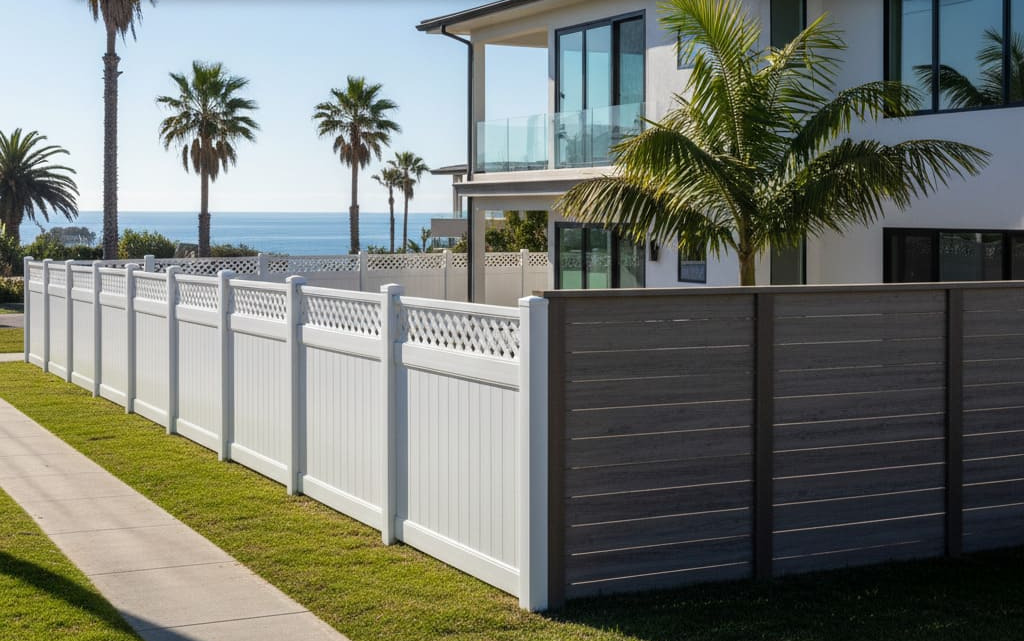
- The Clean & Classic Look (White Vinyl) Vinyl fencing is the backbone of the classic, clean coastal look. Popular styles include Full Privacy, Classic Picket, and Semi-Privacy Lattice-Top.
- The Natural & Premium Look (Composite) Composite is for the property owner who desires the “look of natural wood without the associated drawbacks”. It features earthy tones and deep wood-grain textures.
- The Modern & Edgy Look (Black Fencing) A powerful trend in Santa Monica is black fencing for a "chic," "sleek" statement. This works beautifully to contrast with bright red flowers and green palms.
Part 5: A Comprehensive Cost Analysis
2025 Santa Monica Cost Estimate (Installed)
| Fence Type | Estimated Cost (Per Linear Foot) |
|---|---|
| Standard White Vinyl Privacy Fence | $53.00 – $70.00 |
| Premium Vinyl (e.g., Black HHP) | $65.00 – $90.00 |
| Premium Capped Composite (e.g., Trex) | $120.00 – $155.00+ |
The analysis is clear: the significant premium for composite fencing is not for lower maintenance; both materials excel here. The $120+/ft price is a capital investment in a superior, premium aesthetic.
Part 6: Installation, Permits, and Finding a Pro
The Non-Negotiable: Professional Installation
The single greatest point of failure for synthetic fencing is the failure to account for thermal expansion and contraction. Both vinyl and composite materials “expand in the heat and contract in the cold”.
If panels are installed too tightly without room to “breathe”, the material will buckle and warp, creating a wavy “rollercoaster” appearance.
Santa Monica Fence FAQs
Let's Build Something Lasting
Stop searching and start building. If you are ready to secure your home and boost your curb appeal, let’s talk. We are currently booking for the 2026 season.