Home » Post-Tension Slab vs. Deep Pile: Choosing the Right Foundation for High Water Tables
Get Your Free Estimate
Fill out the form below. We reply within 24 hours.
ON THIS PAGE
- Foundation
Post-Tension Slab vs. Deep Pile: Choosing the Right Foundation for High Water Tables
In our previous article, Building on Coastal Soil, we discussed the unique challenges of the ground beneath Los Angeles and Newport Beach. The biggest culprits? Loose, sandy soil and, most critically, the high water table that sits just beneath the surface in so many coastal neighborhoods.
You can’t just pour a standard “cookie-cutter” foundation here and hope for the best. All that groundwater creates immense “hydrostatic pressure”—a constant, powerful upward push against your foundation.
This leads to a critical question for any LA homeowner: What is the right kind of high water table foundation?
For homes in this environment, it almost always comes down to two high-performance, engineered solutions: a Post-Tension Slab-on-Grade or Deep Pile Foundation Solutions.
Option 1: The Post-Tension Slab-on-Grade
Think of a Post-Tension slab-on-grade as a “super-slab.”
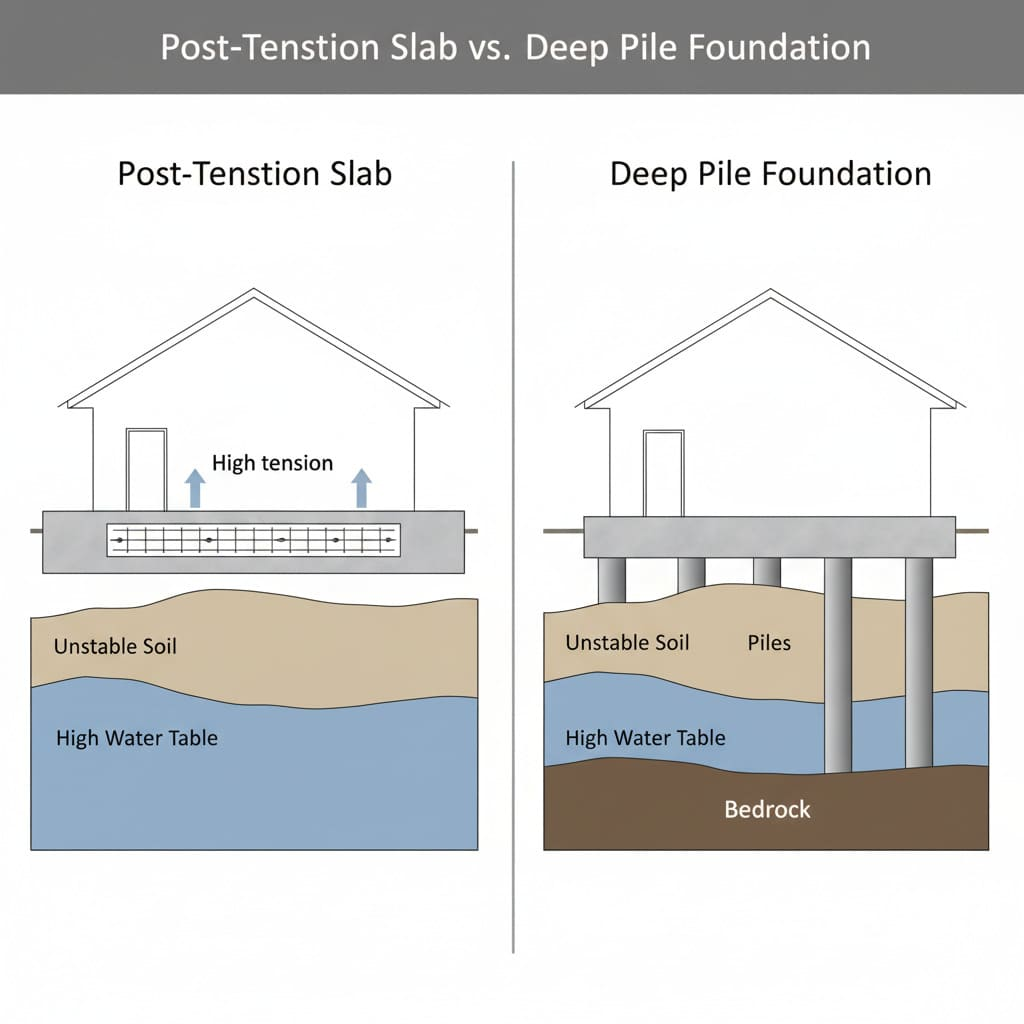
A regular slab is just concrete and static steel rebar. A Post-Tension (PT) slab is an advanced system where high-strength steel cables (called tendons) are run in a calculated grid pattern inside the concrete formwork.
Here’s the magic: after the concrete is poured and begins to cure, we use hydraulic jacks to pull those cables to an extreme amount of tension—often 30,000+ pounds of force. Once they are tight, they are anchored, locking the tension in.
The Analogy: A Squeezed Stack of Books
Imagine trying to pick up a stack of books horizontally by grabbing the sides. If you don't apply pressure, the middle books fall out. But if you squeeze that stack together with immense force, the entire stack becomes a single, rigid beam that you can lift easily.
That is post-tensioning. We are actively squeezing the concrete slab from the inside, holding it in a permanent state of compression.
Why is this good for Coastal LA?
- Monolithic Strength This process makes the slab incredibly strong, flexible, and resistant to cracking.
- Soil Movement It acts as a single, rigid “raft” that can float on top of less-than-perfect soil. If one small area of soil shifts or liquefies slightly, the super-strong slab bridges over it without snapping.
- Hydrostatic Resistance It distributes the home’s weight evenly over a large surface area, which is excellent for counteracting the upward pressure from a high water table.
Option 2: Deep Pile Foundation Solutions
But what if the soil isn’t just “unstable”? What if it’s truly “bad” for several feet down? What if you’re building a heavy, multi-story home in an area like the Balboa Peninsula or Marina del Rey where the water table is just inches away?
In that case, you don’t build on the soil. You build through it.
This is where Deep Pile Foundation Solutions come in. This is the gold standard for a high water table foundation in high-risk zones.
The Analogy: Stilts for Your Home
If a post-tension slab is a raft floating on the water, a pile foundation is a pier driven into the seabed.
Instead of a slab sitting on the surface, this system uses long, powerful columns (the “piles”) made of steel, concrete, or engineered wood. We use massive, specialized equipment to drive, drill, or vibrate these piles deep into the earth.
We keep going down—20, 50, even 80 feet—bypassing all the loose sand, silt, and groundwater, until we hit solid bedrock or a layer of dense, load-bearing soil that can actually support the structure. The house is then built on a grid of concrete grade beams that rest on top of these piles.
Why is this good for Coastal LA?
- Total Stability Your home’s weight is no longer resting on the unstable, wet surface soil. It is anchored to the solid earth far below.
- Eliminates Risk Hydrostatic pressure? Surface soil movement? It doesn’t matter. The piles bypass those problem zones entirely.
- Seismic Security This is one of the best solutions for areas with high liquefaction risk (common in LA basins). The piles anchor the house, preventing it from sinking or tilting during an earthquake even if the surface soil liquefies.
Comparison: Which is Right for You?
| Feature | Post-Tension Slab | Deep Pile System |
|---|---|---|
| Primary Mechanism | "Raft" (Floats on soil) | "Pier" (Anchors to deep bedrock) |
| Best For | Expansive/Shifting Surface Soil | High Liquefaction / Very Poor Soil |
| Cost | Moderate | High |
| Seismic Performance | Excellent (Moves as one unit) | Superior (Anchored stability) |
How Do You Choose? It’s Not a Guessing Game.
This is the most important takeaway: we don’t choose. Your property does.
As coastal soil experts, our first step is never to sell you a product. It’s to partner with a licensed geotechnical engineer. This engineer will take soil borings from your exact lot, analyze the soil composition, measure the water table depth, and calculate the seismic liquefaction potential.
The result is a “Geotechnical Report,” which is the instruction manual for your foundation.
- The report might say: "The soil is moderately expansive. A post-tension slab is required."
- Or it might say: "The top 30 feet are susceptible to liquefaction. Deep piles are mandatory."
Our job as your licensed foundation contractor is to take that scientific report and execute it flawlessly. We have the expertise and equipment to build whichever system the engineering demands.
Don’t Settle for “Good Enough” on Your Foundation. Your foundation is the most critical component of your home. It has to be 100% right.
Are you planning a new custom home or a major remodel in Los Angeles or Newport Beach? Contact Gaga US Construction for a professional consultation. We’ll review your plans and provide the certified, expert-driven foundation your investment deserves.
Frequently Asked Questions
Let's Build Something Lasting
Stop searching and start building. If you are ready to secure your home and boost your curb appeal, let’s talk. We are currently booking for the 2026 season.