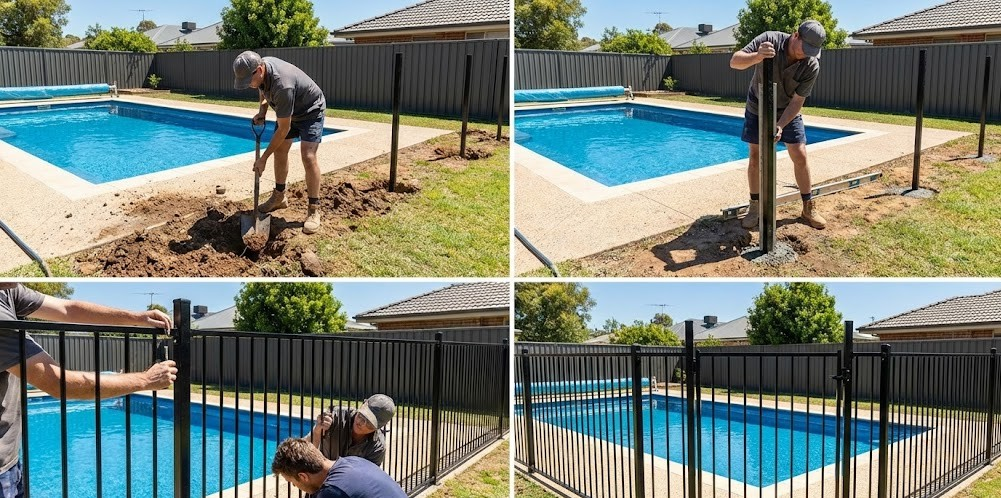
For Los Angeles homeowners, a backyard swimming pool is the ultimate lifestyle asset—a private retreat from the urban sprawl. Yet, this asset comes with a profound responsibility. In California, drowning remains a leading cause of accidental death for young children, a statistic that has driven the state and local municipalities to enforce some of the most rigorous safety barriers laws in the country.
If you are currently searching for "pool fence installation near me," you are likely navigating a complex web of requirements. Is a 48-inch fence enough? Does vinyl withstand the San Fernando Valley heat? Do you need a permit for a simple retrofit?
This comprehensive guide moves beyond basic product descriptions to provide a technical roadmap for compliant pool fence installation in Los Angeles. We will dissect the specific nuances of the Los Angeles Municipal Code, the material science of aluminum and vinyl, and the critical engineering standards required to pass your final inspection.
1. The Regulatory Framework: More Than Just a Fence
Before breaking ground, it is critical to understand that "pool safety" in Los Angeles is not a suggestion—it is a codified mandate. The regulatory hierarchy consists of state law (Senate Bill 442) and local ordinances (LADBS and LA County Public Works), which often impose stricter standards than the state baseline.
Senate Bill 442: The "Two-Device" Rule
Under California's Swimming Pool Safety Act, any new or remodeled pool must be equipped with at least two of seven approved drowning prevention safety features. While alarms and covers are options, a permanent isolation fence is widely regarded by safety experts as the most reliable primary layer of protection because it is "passive"—it works without you having to remember to turn it on.
The City vs. County Distinction
A critical factor often missed by general handymen offering pool fence installation near me is the jurisdictional divide.
- Los Angeles County Generally follows state guidelines allowing for ASTM-compliant removable mesh fencing and standard 60-inch barriers.
- City of Los Angeles The Department of Building and Safety (LADBS) requires that manufactured fencing systems (aluminum, vinyl, and mesh) possess a valid Los Angeles Research Report (LARR) number. This number certifies that the specific product has been tested for structural integrity in seismic conditions. Installing a generic fence without an LARR number in the city limits can lead to a failed inspection.
2. The Geometry of Safety: Height and Gaps
Regardless of the material you choose, the physical dimensions of your barrier must meet strict anthropometric standards designed to prevent a child under five from climbing over or squeezing under.
The 60-Inch Standard
While some older codes allowed for 48-inch or 54-inch fences, the prevailing standard for a compliant pool fence installation near me in Los Angeles is now 60 inches (5 feet). This height is measured from the finished grade on the side of the fence facing away from the pool.
The "Non-Climbable" Zone
A fence is useless if it acts as a ladder. The code strictly regulates the spacing of horizontal rails.
- 45-Inch Rule If the horizontal rails (stringers) are less than 45 inches apart vertically, they must be located on the pool side (inside) of the fence. This ensures the outside face is smooth, leaving a child with no toe-hold.
- Gaps and Clearance To prevent a "crawl-under" event, the gap between the bottom rail and the ground cannot exceed 2 inches. On soft surfaces like grass, inspectors may require a concrete "mow strip" to prevent digging.
3. Material Selection: Aluminum Fencing
Aluminum is often the top result for permanent barriers. It offers a sleek, modern aesthetic that mimics wrought iron without the maintenance headaches.
Corrosion Resistance
Los Angeles air, particularly in coastal zones, carries salt that rapidly corrodes galvanized steel. Compliant aluminum fencing utilizes 6063-T6 marine-grade alloys. The "T6" temper indicates a heat treatment process that maximizes tensile strength.
The Hidden Cost: Electrical Bonding
A technical detail that frequently blindsides homeowners is "equipotential bonding." If your aluminum fence is installed within 5 feet of the water's edge, the National Electrical Code (NEC 680) requires it to be bonded to the pool's grounding grid.
An electrician must trench and run an 8 AWG solid copper wire from the fence posts to the pool shell's bonding loop. This prevents "stray voltage" shocks and can add $1,000+ to the project cost.
4. Material Selection: Vinyl (PVC) Fencing
Vinyl fencing has gained popularity in the San Fernando Valley and inland areas for its privacy and cooling properties.
Thermal Performance and UV Stability
Unlike aluminum, vinyl remains cool to the touch. However, cheap vinyl degrades rapidly under the high UV index of Southern California. Ensure your contractor uses "mono-extruded" vinyl with high levels of Titanium Dioxide (TiO2) inhibitors. This prevents the fence from shattering upon impact after years of sun exposure.
The "No-Bonding" Advantage
Because vinyl is non-conductive, it does not require electrical bonding, even if installed right at the water's edge. For homeowners with tight deck spaces, this is often the most cost-effective compliant solution.
Note on Structure: Vinyl lacks inherent rigidity. For code compliance, gate posts must be reinforced with internal steel or aluminum "stiffeners" to prevent warping.
5. The Mechanics of Access: Gates and Latches
The gate is the only dynamic part of the system and statistically the most common point of failure. When vetting contractors, scrutinize their hardware choices.
- Outward Swing The gate must open away from the pool. If a child pushes on it, it pushes tighter against the latch rather than popping open.
- Self-Closing Mechanics The gate must close and latch automatically from any open position—whether fully open or just slightly ajar.
- Latch Height The release mechanism must be located at least 60 inches above the ground. We recommend MagnaLatch® technology for zero-friction engagement.
6. Navigating the Permit Process
Do you really need a permit for pool fence installation near me? In most cases, yes.
- New Construction The fence is part of the overall pool permit. The "final" inspection cannot be signed off until the barrier is up.
- Masonry Walls Any masonry wall (block, stucco) over 3.5 feet requires a permit and engineering calculations due to seismic overturning risks.
- Climbable Object Radius The code mandates a clear zone (usually 36-48 inches) on the outside of the fence. Pool equipment, AC units, or potted plants in this zone are violations.
7. Cost Analysis: Investment vs. Liability
While the upfront cost is significant, a compliant fence lowers liability exposure and prevents insurance cancellation. Here is how the materials compare:
Mid-range option. High durability, excellent resale value, modern aesthetic.
Comparable to aluminum. Best for privacy and heat resistance. No bonding required.
Most affordable compliant option. Focus is on removability and safety rather than architectural style.
The premium option. Obstruction-free views, but higher maintenance and cost.
Conclusion: Choosing the Right Partner
Selecting a contractor for pool fence installation near me is not about finding the lowest bid; it is about finding a partner who understands the difference between a "fence" and a "safety barrier."
In Los Angeles, the right contractor will verify LARR approval (essential for City residents), understand equipotential bonding to avoid electrical hazards, and guarantee gate compliance. Your pool should be a source of joy, not anxiety. Prioritize safety and compliance above all else—your peace of mind is worth the investment.