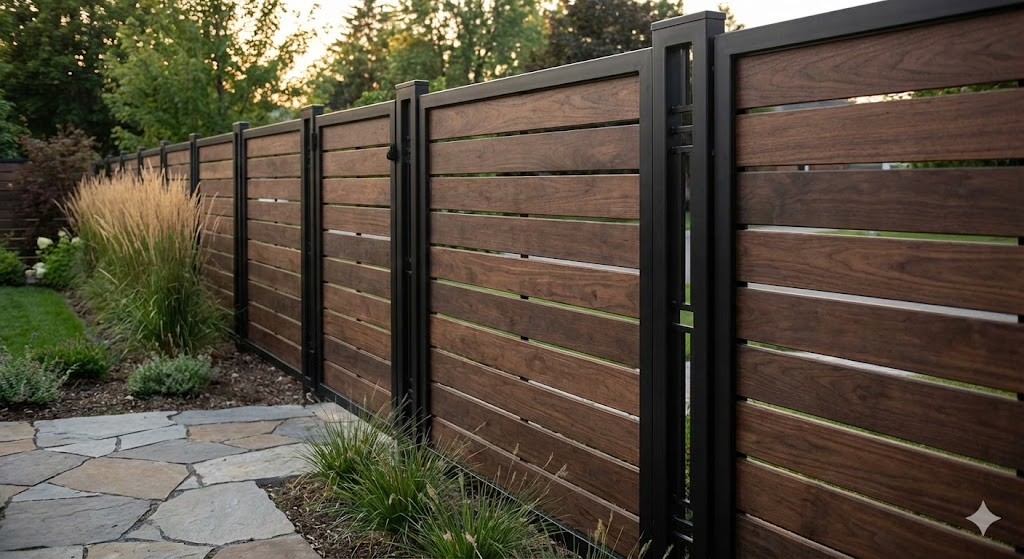
The residential boundary in Los Angeles has evolved. It is no longer just a utilitarian line drawn in the dirt; it is a sophisticated architectural statement. As we navigate 2025, the humble "fence" has become a central player in the "indoor-outdoor" living ethos that defines Southern California real estate.
A monolithic shift is underway. We are moving away from the homogenous, quickly degrading dog-ear wood fences of the past toward "Mixed Material Fencing (Metal & Wood)"—complex systems that hybridize the warmth of timber with the structural resilience and industrial aesthetic of metal.
Why the shift? It is driven by two uniquely LA pressures: the desire for "curated privacy" in densifying neighborhoods and the rigorous new fire safety codes prompted by our wildfire risks. This guide breaks down why mixing materials is the smartest move for your property.
1. The Big Three: Defining the LA Look
The core of this trend lies in the tension between organic wood and industrial metal. Three primary typologies have come to dominate the Los Angeles market:
The "Industrial Chic": Wood Frame + Corrugated Metal
Seen everywhere from Venice to the Arts District, this style uses substantial wood posts (4x4 or 6x6) to frame sheets of corrugated metal. The wood softens the harshness of the metal, while the metal provides absolute privacy and an effective sound barrier against urban noise.
Pro Tip: We often use "Galvalume" metal rather than standard galvanized steel to resist rust in coastal zones.
The "Modern Minimalist": Steel Posts + Horizontal Slats
This is the definitive look for modern renovations. By swapping rot-prone wood posts for black galvanized steel columns, we create a structure where the horizontal wood slats appear to "float." This horizontality elongates the perceived width of the property, making narrow 40-foot LA lots feel expansive.
The "View Preserver": Wood Frame + Hog Wire
In the hills of Silver Lake and Mount Washington, the view is the asset. Solid fences destroy value here. The solution is "Hog Wire"—a heavy-gauge welded wire mesh framed in high-quality Cedar or Redwood. It keeps the dog in but leaves the skyline visible.
2. Material Science: The "Forever Post"
The defining structural innovation of the mixed-material trend is the abandonment of the wood post. A 4x4 wood post buried in LA soil acts as a wick for moisture. Even with concrete footings, rot is inevitable at the collar.
The Solution: We use galvanized steel posts (like the Master Halco PostMaster or Schedule 40 pipe). These are impervious to rot and termites. By using metal posts, the structural lifespan of your fence extends from 15 years to 40+ years. You can replace the wood infill later without ever re-digging the foundation.
3. Engineering for the Santa Anas
In Los Angeles, a fence must withstand the Santa Ana winds—seasonal gusts that can reach 60-80 mph. A solid corrugated metal fence acts as a sail. If not engineered correctly, it will fail.
The critical concept here is permeability. We often recommend horizontal wood slat fences with a 1/2-inch gap between boards. This gap allows wind pressure to equalize, significantly lowering the stress on the posts compared to a solid wall.
4. Fire Safety: The "Zone 0" Mandate
The 2025 landscape for fencing is heavily influenced by the insurance industry. A wood fence attached to a home acts as a "fuse," carrying fire from the yard directly to your eaves.
New regulations are establishing "Zone 0"—the 5-foot buffer immediately surrounding your home. Fencing in this zone must be non-combustible. This is why mixed material is crucial: we can install a steel or aluminum gate section attached to the house, transitioning to wood further out, breaking the path of the fire.
5. Navigating the Zoning Maze
Before you fall in love with a design, you must understand the rules of the City of Los Angeles Department of Building and Safety (LADBS).
- The 42-Inch Rule In your front yard setback (usually the first 15 feet), fences generally cannot exceed 42 inches in height. A 6-foot privacy fence at the sidewalk is a code violation.
- HPOZ Restrictions If you live in a Historic Preservation Overlay Zone (like Hancock Park or Jefferson Park), modern horizontal slats or corrugated metal may be prohibited to preserve the historic character. Always check ZIMAS first.
- Hillside Ordinance In the hills, fence height is measured from the "natural grade," preventing you from building up a dirt pad to artificially heighten your wall.
6. Cost vs. Value
Investing in a custom mixed-material fence is more expensive upfront than a standard dog-ear fence, but the ROI is compelling.
Requires staining every 2 years. Posts likely rot within 10-12 years.
Steel posts last 40+ years. "Curb appeal" premium can increase home value by 1-3%.
Zero maintenance. The ultimate choice for "forever homes" or high-end estates.
Conclusion
For the Los Angeles homeowner in 2025, the decision to install a mixed-material fence is a strategic one. It represents a departure from the disposable culture of the past toward a mindset of permanence and resilience.
Whether maximizing a view in the Hills with hog wire or creating a private sanctuary in Venice with corrugated steel, GAGA US Construction has the engineering expertise to build a boundary that stands the test of time.