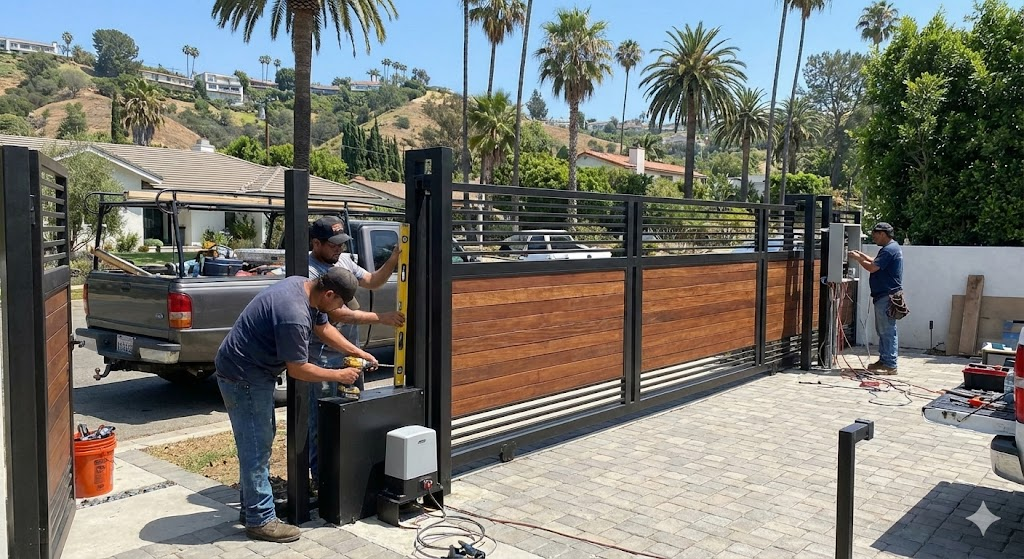
In Los Angeles, the driveway gate is more than an entryway; it is the first line of defense and a definitive statement of architectural style. From the secluded estates of the Hollywood Hills to the modern compounds of Venice Beach, an automatic gate transforms a property's perimeter into a sophisticated security node.
As we move into 2025, the humble electric gate has evolved. It is no longer just a motorized barrier but a connected device integrated with smart home ecosystems, capable of recognizing your vehicle and resisting the unique environmental challenges of Southern California. If you are considering automatic gate installation in Los Angeles, this guide navigates the complex intersection of municipal compliance, advanced engineering, and cutting-edge security technology.
1. The Regulatory Reality: Zoning and Compliance
Installing an automated gate in Los Angeles is not a simple DIY project; it is a construction event governed by rigorous city codes.
Setback Requirements
The City of Los Angeles enforces strict setback rules to ensure traffic safety. Gates cannot simply be placed on the property line if it causes a waiting vehicle to block the sidewalk or street. In many multifamily zones, a gate must be recessed 18 to 20 feet from the curb—the length of a standard car—to allow for safe queuing.
Emergency Access (The Knox Box)
Your gate cannot block first responders. The Los Angeles Fire Department (LAFD) mandates the installation of a Knox key switch. This device allows fire crews to override your gate's motor during an emergency.
It must be mounted between 5.5 and 6 feet high and be clearly marked with an "FD ACCESS" sign. Furthermore, in the event of a power outage, the gate must have a manual release or a fail-safe battery backup that opens the gate automatically to prevent entrapment during evacuations.
Hillside Ordinances
For properties in the designated Hillside Areas, the "Baseline Hillside Ordinance" dictates that driveway width must be at least 9 feet. This seemingly minor detail impacts the structural opening of your gate and the type of hinge or track system required.
2. Engineering for Los Angeles Topography
The diverse terrain of Los Angeles—from the flat grid of the Valley to the steep, winding roads of Bel Air—dictates the mechanics of your gate.
The Sliding Gate Advantage
For steep driveways, a sliding gate is often the only viable engineering solution. Because it moves horizontally across the grade rather than swinging outward, it is indifferent to the slope of the driveway. This design maximizes usable parking space and eliminates the risk of a swing gate scraping the pavement or bottoming out on an incline.
Swing Gates and Gravity
If you prefer the classic aesthetic of a swing gate on a hill, specialized engineering is required. Hydraulic operators are superior to electromechanical ones in this application. They act as a braking system, preventing the heavy gate leaves from slamming due to gravitational pull, and provide the high torque needed to combat wind loads during Santa Ana events.
3. Smart Security: The Connected Perimeter
The modern "smart gate" integrates seamlessly with your digital life, offering convenience without compromising security.
- License Plate Recognition (LPR) Specialized cameras use Optical Character Recognition (OCR) to check plates against an "allow list." If your car is recognized, the gate opens automatically.
- Video Intercoms & SIP Legacy systems are being replaced by IP-based video intercoms (e.g., ButterflyMX, DoorKing). Using SIP (Session Initiation Protocol), these provide crisp two-way audio and video via smartphone, allowing you to grant access from anywhere in the world.
- Solar Power Viability With over 5 peak sun hours per day in LA, solar is viable. However, to combat the "parasitic load" of always-on Wi-Fi bridges, you need at least a 30-watt panel and deep-cycle AGM batteries to survive "June Gloom."
4. Material Science: Surviving the LA Climate
Your gate materials must withstand intense UV radiation, dry heat, and coastal salt air.
- Wood-Like Aluminum Real wood requires annual staining. The current trend is powder-coated aluminum that mimics the warmth of cedar or walnut but is impervious to termites, rot, and fire.
- Privacy Glass For modern homes, gates incorporating frosted or "rain" glass panels are trending. They offer total visual privacy while allowing light to filter through.
- Wrought Iron While traditional, iron requires galvanization and high-quality epoxy paint to resist rust, especially in coastal zones like Santa Monica.
5. Cost Analysis for 2025
Investing in an automatic gate is significant. In the Los Angeles market for 2024-2025, here is what homeowners can expect:
Standard steel or aluminum sliding gate with a reliable motor (e.g., LiftMaster).
Custom fabrication, hydraulic operators, extensive masonry work, and smart LPR/Intercom integration.
Annual service to lubricate chains, align sensors, and test safety reversal systems.
Conclusion
An automatic gate installation is a complex interplay of design, law, and engineering. It requires a partner who understands not just how to weld metal, but how to navigate LA's zoning codes and integrate sophisticated electronics.
By choosing the right materials and technology today, you secure your property with a system that offers peace of mind and effortless luxury for years to come.