Get Your Free Estimate

Fill out the form below. We reply within 24 hours.

ON THIS PAGE

Aluminum Fence Installation: Classic Elegance, Modern Durability

Hrayr Shahnazaryan
Written By Hrayr Shahnazaryan
Technically Reviewed By Arsen Akopyan Lic #1074874
Last Updated
Aluminum Fence Installation
There is a specific myth in Los Angeles architecture that "Wrought Iron" is the only choice for a premium home. For nearly a century, from Hancock Park to the Palisades, iron was the standard. But let’s be honest about the reality of owning iron in 2025: it fights a losing battle against the ocean air, and maintenance labor costs are skyrocketing.

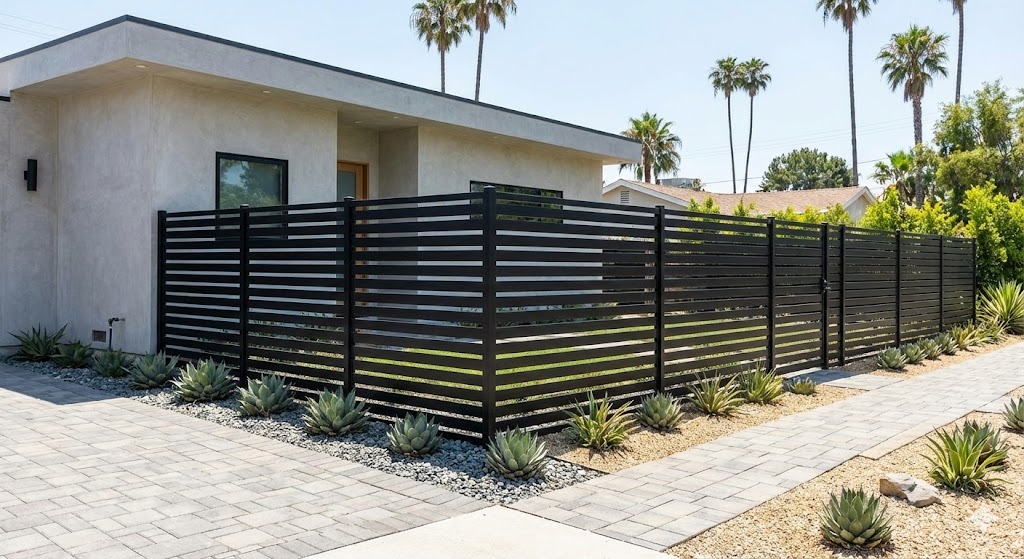
At GAGA US Construction, we are seeing a massive shift. The "romantic" idea of iron is being replaced by the pragmatic performance of aluminum. This isn't the flimsy material you see at big-box stores; modern architectural aluminum mimics the weight and profile of iron but eliminates the rust. For our clients—whether you are a homeowner in the Hills or a developer in Santa Monica—this guide explains why aluminum is the superior engineering choice for our specific climate and topography.

The Rust Problem: Why Steel Fails in LA

To understand the switch, you have to look at what happens to steel (often mislabeled as "wrought iron") in Southern California. Modern "iron" fences are usually mild carbon steel. In LA, especially west of the 405, steel reacts with oxygen and moisture to create iron oxide (rust).

This isn't just cosmetic. Rust expands. When a steel post rusts inside a concrete footing, it expands and cracks the concrete—a process called "oxide jacking." We see this constantly on job sites: spalled concrete and wobbly posts that require total demolition.
❌ Steel/Iron: The Rust Failure
Ground Soil Steel Post Cracked Concrete RUST EXPANSION

Rust expands, cracking the concrete foundation ("Oxide Jacking").

✅ Aluminum: The Passive Seal
Ground Soil Aluminum Post Solid Footing NO EXPANSION

Forms a microscopic seal. Concrete footing remains secure forever.

The Aluminum Advantage

Aluminum is reactive, but in a good way. When exposed to oxygen, it instantly forms a microscopic "passive layer" that seals the metal. If you scratch an aluminum fence, the exposed metal instantly oxidizes and seals itself. It effectively "heals" and cannot rust.

The LA "Triple Threat": Salt, Sun, and Wind

Building in Los Angeles means defending against three specific environmental aggressors. If your fence isn't engineered for these, you are throwing money away.
  • The Marine Zone (West of the 405) If you live in Marina Del Rey, Venice, or the Palisades, the marine layer brings chloride ions (salt) onto your property every night. Steel fences here have a lifespan of 3-5 years before they need aggressive sanding. Aluminum is chemically resistant to chlorides.
  • UV Radiation & Chalking LA gets 284 sunny days a year. High UV destroys cheap paint, leading to "chalking"—where a black fence turns into a dusty grey eyesore. We use specific powder coatings (AAMA 2604/2605) designed to resist this.
  • Santa Ana Winds In the foothills, wind gusts can hit 70+ mph. Solid fences act like sails and snap. Open picket aluminum fencing lets the wind pass through, putting almost no torque on the footings.

Installation: Conquering the Topography

Los Angeles isn't flat. The geology here dictates how we install. One of the biggest mistakes amateur installers make is "Stepping" the fence on a hill. Stepping looks like a staircase. This creates a triangular gap under the low end of every panel—a highway for coyotes, skunks, and rodents. Racking is the GAGA US standard. We use panels with pivot points, allowing the fence to "shear" and follow the angle of the ground. It keeps the bottom rail close to the dirt (keeping pets in) and looks significantly cleaner.
❌ The Wrong Way: "Stepping"
WILDLIFE GAP

Creates ugly gaps that pets and pests can slip through.

✅ The GAGA Way: "Racking"
SECURE FIT

Follows the terrain perfectly. No gaps, cleaner aesthetic.

The Installation Process: The GAGA US Way

We don't just dig holes; we engineer the perimeter. Here is how we ensure your aluminum fence lasts decades.
5-Step Installation Process
1
Grade Analysis
Measuring slopes to determine if standard racking or custom "double-punched" panels are needed.
2
Material Spec
Selecting the right alloy (6063-T5) and Coating Grade (AAMA 2604 or 2605).
3
Deep Set
Posts set 24-36" deep in concrete to bypass LA's expansive clay soil layer.
4
Precision Assembly
Racking panels to follow terrain contours while maintaining pool code gaps (<4").
5
Final Seal
Cap installation and site cleanup. Aluminum requires zero post-install painting.

Codes & Compliance: Avoiding the Red Tag

The hardest part of an LA build isn't the construction; it's the permitting.

The 42-Inch Rule

In most R-1 zones, your front yard fence cannot exceed 42 inches. Aluminum works best here because it provides a clearly defined property line without the bulk of masonry. It looks secure without looking like a fortress, which helps with neighborhood councils.

Pool Safety (SB 442)

If you are putting in a pool, the inspector will measure your fence down to the inch based Senate Bill 442.
  • Height: Must be 60 inches (5 feet) minimum.
  • Gaps: No gaps larger than 4 inches (prevents a child's head from fitting).
  • Climbability: No mid-rails that act as a ladder.
Aluminum is the industry standard here because it is rigid. Unlike mesh or vinyl, you can't pry the pickets apart.

The Bottom Line: Cost vs. Value

Construction is expensive in LA. Here is the honest breakdown. Wood is cheapest upfront but has a "Total Cost of Ownership" that doubles over 10 years due to staining and rot repair. Iron has high upfront costs and high maintenance. Aluminum sits in the middle upfront—approx. 15% more than wood—but has zero maintenance. It breaks even with wood around Year 5 and becomes the cheapest option by Year 10 because you never have to touch it again.

Our Final Verdict

For the Los Angeles market, aluminum has dethroned iron. It provides the architectural "gravitas" required for high-end homes without the liability of rust or fire risk. Our advice: Go Matte Black for the aesthetic, use Rackable Panels for the topography, and invest in AAMA 2605 coatings if you can smell the salt air. It is a "set it and forget it" solution.

Frequently Asked Questions

Can I automate my aluminum driveway gate later, or do I need to decide now?

You can automate later, but you need to prep now. The biggest mistake homeowners make is pouring a concrete driveway without running conduit (PVC pipe) underneath it first. If you think you might want an electric opener in the future, tell us before we install. We need to:

  1. Reinforce the Gate: Aluminum is lightweight. We weld a specific “operator bar” across the middle of the gate so the automatic arm has something solid to push against. Without this, the opener can bend your pickets.

  2. Lay the Conduit: We ensure the electrical path is ready so you don’t have to jackhammer your new driveway in two years just to run a wire.

Yes, significantly easier.

  • Iron Repair: Because iron fences are often welded into one continuous piece, repairing damage usually means cutting out a massive section with a grinder, re-welding on-site (which creates sparks and mess), and then hand-painting it. The paint match is rarely perfect, and the weld spots often rust later.

  • Aluminum Repair: Aluminum systems are modular. If a tree crushes two panels, we simply unscrew those specific panels from the posts and slot in new factory-finished replacements. It is a clean, bolt-on repair that looks brand new and maintains the integrity of the powder coat.

Proceed with caution. This is a common point of failure in LA. Many old retaining walls (especially the crumbly concrete ones from the 1950s) are not strong enough to hold a fence in a high wind. If we drill into them, they might crack.

  • The Solution: We often use a “Core Drill” method. Instead of bolting a plate to the top (which is weak), we drill a round hole into the wall, insert the post deep inside, and fill it with hydraulic cement. If the wall is too weak, we must dig new footings behind the wall to ensure the fence stands independently of the aging masonry.

It gets warm, but it won’t burn you like steel does.

  • The Physics: Steel is dense and holds heat like a cast-iron skillet—it stays hot long after the sun moves. Aluminum has high thermal conductivity, meaning it dissipates heat very quickly.

  • The Reality: While a black aluminum fence in direct 100°F Valley sun will feel hot to the touch, it cools down almost instantly when a breeze hits it or the angle of the sun shifts. It rarely causes the “contact burn” issues that heavy wrought iron can. If you are extremely concerned (e.g., for a preschool), we can spec a lighter color like Bronze or White, but Matte Black is the industry standard and is generally safe.

Let's Build Something Lasting

Stop searching and start building. If you are ready to secure your home and boost your curb appeal, let’s talk. We are currently booking for the 2026 season.

Scroll to Top

What Local Families Are Saying

Follow Us

Got a Project Idea?

Name

The L.A. Next Masterpiece Starts Here

Schedule Your Free Los Angeles Consultation