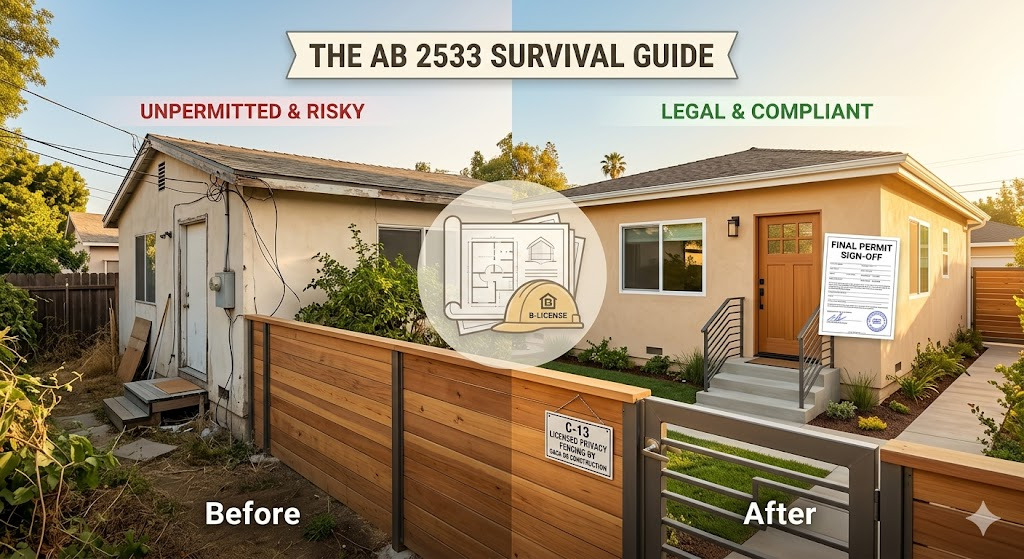
If you have an unpermitted guest house, garage conversion, or backyard ADU in Los Angeles, you are not alone – and you are not stuck. California’s new AB 2533 “amnesty” law creates a structured path to legalize many of these units without the nightmare of huge penalties, forced evictions, or demolition orders.
At Gaga US Construction, we see AB 2533 as a once‑in‑a‑generation opportunity for homeowners: you can turn a risky, under‑the‑radar unit into a legal, income‑producing asset – safely, transparently, and on your terms.
What Is AB 2533 And Why Does It Matter For Your ADU?
AB 2533 is a California state law that expands a statewide “amnesty” program for unpermitted accessory dwelling units (ADUs) and junior ADUs (JADUs). In simple terms, it tells cities like Los Angeles: “If a unit was built before January 1, 2020 and can meet basic health and safety standards, you cannot deny a permit just because it was originally built without one.”
That is a huge shift from the old days when the city’s first instinct was to red‑tag, fine, or order removal. Under AB 2533 and LA’s existing Unpermitted Dwelling Unit (UDU) ordinance, the focus is now on bringing “hidden housing” into the light, fixing life‑safety issues, and keeping people housed – not punishing homeowners for past mistakes.
In Los Angeles alone, experts estimate there are tens of thousands of informal or unpermitted ADUs built before recent reforms. AB 2533 is designed specifically to help owners of these units get legal, protect their property value, and contribute to the city’s housing supply without starting from zero.
Who Qualifies For ADU Amnesty In Los Angeles?
While each jurisdiction implements details slightly differently, the core AB 2533 framework is the same statewide. In general, your unit may qualify for amnesty if:
- It is an ADU, JADU, or similar dwelling unit located on a residential property.
- It was constructed without proper permits before January 1, 2020.
- It can be brought up to basic health and safety standards – structurally sound, safe exits, adequate light and ventilation, safe electrical and plumbing, and fire safety.
- It does not have severe hazards that cannot reasonably be corrected (for example, extreme structural failure or unsafe location conditions).
In Los Angeles, this amnesty path works hand‑in‑hand with the City’s Unpermitted Dwelling Unit (UDU) program, a voluntary process that already allows certain older units to be legalized if life‑safety conditions and affordability requirements are met. AB 2533 strengthens this by restricting when cities can say “no” to legalization and by exempting some local zoning and energy‑code requirements when you are legalizing an existing unit rather than building a new one from scratch.
Why Most Homeowners Are Afraid To Come Forward
If you are reading this and thinking, “I don’t want the City anywhere near my property,” that is completely normal. Many Los Angeles homeowners with unpermitted ADUs worry about:
- Retroactive fines and penalties for building without permits in the past.
- Being forced to evict tenants, cut off utilities, or demolish the unit.
- Triggering a chain of inspections that expose other issues on the property.
- The complexity and cost of plans, engineering, and construction repairs.
AB 2533 is designed to calm some of those fears by creating a “no‑penalty” path for qualifying units and by clearly separating life‑safety corrections (which must be done) from cosmetic issues that are less critical. But a law on paper is not enough – you still need a practical strategy and an experienced construction partner who speaks both “city” and “homeowner.”
Gaga US Construction: Your “Safe Path” To Legalization
Gaga US Construction positions itself as that safe path. We do not just pull permits; we manage the entire journey from “unpermitted and stressful” to “legal, finance‑able, and income‑producing.”
Two key licenses set us apart in the AB 2533 space:
- B‑License (General Building Contractor) – This allows us to handle structural retrofits, framing corrections, foundation upgrades, and the full scope of building‑code work required to bring an older or informal ADU up to structural safety standards.
- C‑13 Fencing Contractor License – Under California’s C‑13 classification, a fencing contractor constructs, erects, alters, or repairs all types of fences, railings, guard rails, barriers, and enclosures. For ADU amnesty projects, this is critical for privacy fencing, required property line barriers, and safety rails that satisfy Los Angeles zoning and screening requirements without triggering unnecessary redesigns.
Together, these licenses mean we can design and execute a legalization plan that covers both the heavy structural work and the mandatory privacy and safety elements in one coordinated scope, instead of forcing you to juggle multiple contractors.
Step‑By‑Step: How AB 2533 Legalization Works In Real Life
While every property is different, most Los Angeles AB 2533 / ADU amnesty projects follow a similar sequence. Here is how Gaga US typically guides a homeowner from first call to final sign‑off.
1. Confidential Site Assessment
We start with a low‑stress, on‑site review of your existing unit: structure, access, utilities, and obvious code issues. The goal is to understand what you actually have – not to scare you.
We compare your situation against AB 2533 eligibility criteria and LA’s UDU program rules to confirm whether the unit is a good candidate for amnesty. If there are red‑flag hazards that could kill the project, we tell you upfront before you spend money on plans.
2. As‑Built Plans, Engineering, And Code Strategy
Once we are confident you have a viable candidate, our team documents “as‑built” conditions and brings in structural engineers as needed to address framing, foundation, and lateral stability. Under AB 2533, the focus is on health and safety rather than forcing a 1970s garage conversion to meet every inch of current code for a brand‑new build.
We develop a targeted scope of work that:
- Corrects structural deficiencies so the shell is safe in earthquakes and weather events.
- Brings electrical, plumbing, and mechanical systems to safe, permitted standards.
- Addresses egress, emergency exits, smoke and CO detectors, and fire‑resistant separations where required.
- Plans for required privacy fencing or screening so your ADU meets setback and neighbor‑privacy expectations.
3. Permit Application Under AB 2533 / UDU
With a clear plan in place, Gaga US prepares and submits your permit package to the City of Los Angeles, flagging it specifically as an AB 2533 / UDU amnesty project where applicable. Under state law, the city cannot deny a permit for a qualifying unpermitted ADU solely because it violates local zoning or development standards; instead, it must focus on whether the unit can be made safe.
If there is already a Notice of Violation on your property, AB 2533 explicitly allows you to still apply for a permit and then correct the listed items under that permit rather than fighting the notice in the dark. This turns an adversarial situation into a structured fix‑it path.
4. Construction, Structural Retrofitting, And Privacy Fencing
After permits are issued, our B‑licensed team executes the structural and life‑safety upgrades: foundation work, wall reinforcement, moisture and weather protection, and corrections to stairs, rails, and decks. Many older garage conversions, for example, need upgraded footings, proper insulation, and fire‑rated assemblies between the ADU and the main house – all items we routinely handle.
In parallel, our C‑13 fencing division designs and installs any required privacy and safety enclosures. This can include:
- Six‑foot perimeter privacy fences to shield ADU patios from neighboring yards, where allowed by code.
- Guard rails and barriers at elevated decks, stairs, or retaining walls to meet fall‑protection requirements.
- Driveway gates or side‑yard enclosures that secure separate ADU access while protecting the main household.
Because fencing and barriers are specifically within the C‑13 scope, we can guarantee that these elements are both code‑compliant and aligned with your design goals instead of being an after‑thought tacked on at the final inspection.
5. Inspections, Final Approval, And Peace Of Mind
Gaga US coordinates all required city inspections – building, electrical, plumbing, mechanical, and any housing‑department checks tied to the UDU program. If the inspector requests minor corrections, we handle them quickly and transparently so you are never left negotiating in the field alone.
Once the unit passes final inspection, you receive formal documentation showing that your ADU is legalized under AB 2533 and local UDU rules. At that point, you can confidently:
- Advertise the unit as a legal rental.
- Work with lenders who recognize the extra income for refinancing or resale.
- Sleep at night knowing a complaint or drive‑by inspector will not upend your life.
Key Benefits Of Legalizing Your Unpermitted ADU Now
Waiting may feel safer, but in reality, acting during an amnesty window is often the least risky option. Here is what you gain by moving forward under AB 2533 with a structured plan:
- No retroactive penalties for qualifying units built before the cutoff date, as long as you cooperate with the legalization process.
- Predictable path: the law lays out clear expectations for what the city can and cannot require on existing units.
- Higher property value: legalized ADUs typically appraise higher because lenders and buyers can count the rental income.
- Reduced liability: properly permitted structures with corrected life‑safety items reduce your risk in the event of accidents or disasters.
- Protected tenants: instead of sudden displacement from a red‑tagged unit, occupants get a safer home and more stability.
What “Structural Retrofitting” Really Means For Your ADU
Many owners hear “structural retrofit” and imagine massive demolition, but that is not always the case. For AB 2533 amnesty projects, the focus is on making existing structures safe and durable, not rebuilding them as if they were brand‑new custom homes.
Typical retrofit work on an older LA guest house or garage conversion can include:
- Reinforcing inadequate foundations or adding new footings at load‑bearing walls.
- Adding shear walls, hold‑downs, and proper connections to improve earthquake performance.
- Correcting sagging roof lines, damaged headers, or under‑sized beams.
- Improving water‑proofing, drainage, and weather protection to stop rot and mold.
With a B‑license and experience in ADUs, Gaga US can phase this work intelligently so you are not over‑spending on items the city does not actually require for amnesty approval.
Why Privacy Fencing Is Not Just A Cosmetic Detail
Privacy is a big part of why many neighbors oppose ADUs – and why some projects get bogged down in complaints. Los Angeles zoning and building rules frequently require fencing, guard rails, or screening to protect adjoining properties and ensure safe separation of uses.
Because a C‑13 fencing contractor is specifically licensed to construct fences, barriers, and guard rails, Gaga US can:
- Design fence heights and locations that align with local code while delivering real visual privacy.
- Integrate gates and access control so your ADU feels like its own small home, not an afterthought in the backyard.
- Use materials that complement your main house and meet durability and safety expectations.
In an AB 2533 legalization project, these elements are not optional: they are often part of the life‑safety and neighbor‑impact review that determines whether your unit can be approved without major redesign.
Ready To Turn Your “Secret” ADU Into A Legal Asset?
If you are in Los Angeles with an unpermitted guest house, garage conversion, or backyard ADU, AB 2533 and the City’s UDU program give you something you did not have before: a clear, time‑sensitive path out of the gray zone. You do not have to navigate it alone.
Gaga US Construction combines structural retrofitting expertise, a B‑License for full building work, and a C‑13 fencing license for privacy and safety enclosures to deliver a turnkey “Safe Path” to ADU amnesty. From first inspection to final sign‑off, our job is to shield you from the fear of dealing with the city while turning your unpermitted unit into a compliant, income‑generating, long‑term asset.
Reach out to the Gaga US team today, and let us map out your personalized AB 2533 Survival Plan – so your LA guest house stops being a liability and starts working for you.