Home » Composite vs. Ipe: The Best Decking for Newport Beach Salt Air
Get Your Free Estimate
Fill out the form below. We reply within 24 hours.
ON THIS PAGE
- Outdoor Improvement
Composite vs. Ipe: The Best Decking for Newport Beach Salt Air
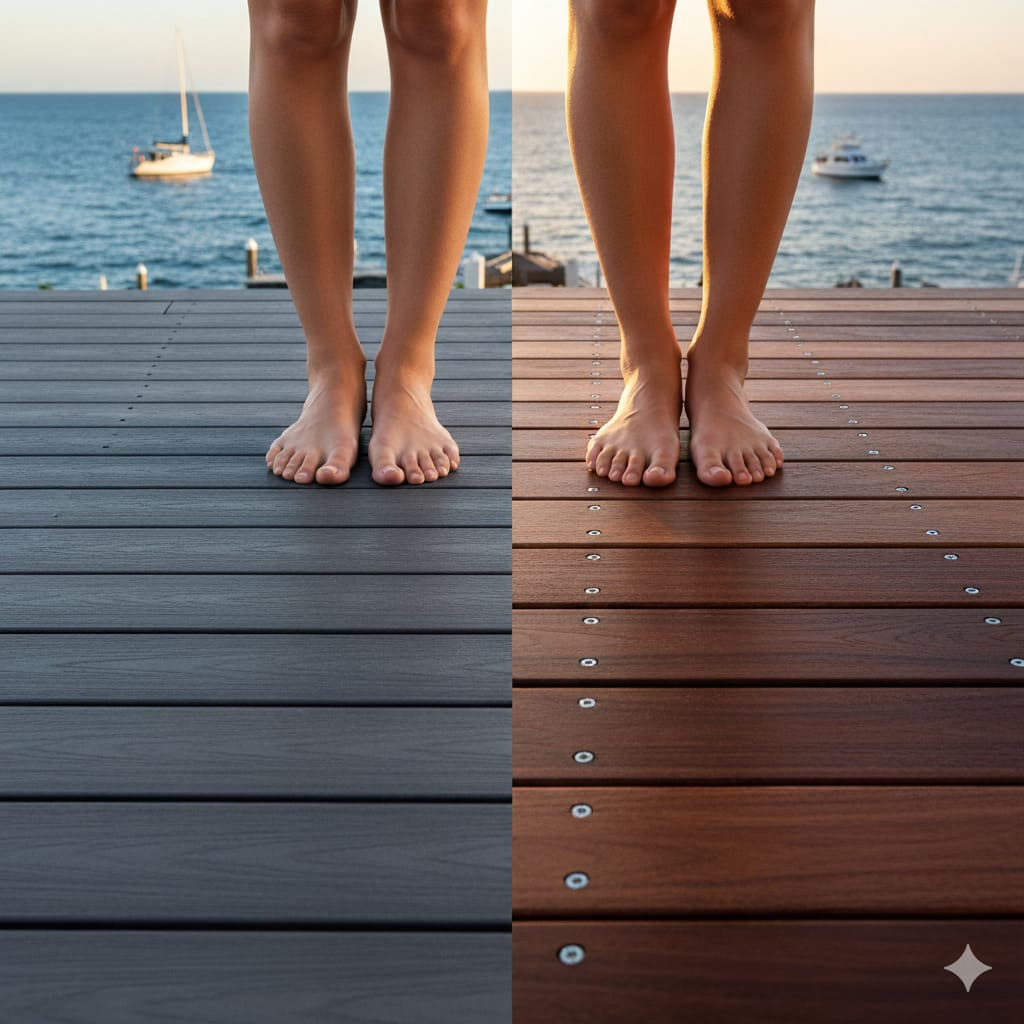
You’re standing on your property, looking out at the harbor or feeling that coastal breeze. You’re ready to build the deck that will complete your outdoor living space. But now you face the single most important choice for your project: what material will you be standing on?
In Newport Beach, this isn’t a simple aesthetic choice. It’s a technical one. The constant exposure to salt, sun, and moisture creates one of the harshest environments for any building material. Choose right, and you’ll have a stunning, low-maintenance retreat for decades. Choose wrong, and you’ll be dealing with splinters, rot, and faded boards in just a few years.
As a premier custom deck installation team in Newport Beach, we’ve built, repaired, and replaced countless decks. The conversation always comes down to two top-tier contenders: high-end Composite Decking and exotic Ipe hardwood.
So, let’s settle the debate. Which one is truly best for your coastal home?
The Contender: Premium Composite Decking
When we say composite decking in Newport Beach, we are not talking about the cheap, plastic-y boards from 20 years ago. Today’s high-end “capped composite” decking (from brands like Trex, TimberTech, and Azek) is a technological marvel.
It’s made from a core of recycled wood fibers and polymers, “capped” in a tough, non-porous shell that provides near-total protection.
The Pros of Composite:
- Virtually No Maintenance This is its number one selling point. No sanding. No staining. No sealing. Ever. You just wash it with soap and water.
- Resists Salt & Sun The high-performance cap is UV-resistant and won’t fade or discolor. Salt spray can be rinsed right off and won’t corrode or stain the material.
- No Rot, Splinters, or Insects Because it’s fully synthetic, there is nothing for moisture to rot, no splinters for bare feet, and nothing for termites to eat.
- Stunning Aesthetics (Now) Modern composites have incredibly realistic wood grains, colors, and textures, from modern grays to rich tropical browns.
The Cons of Composite:
- Heat Retention Darker-colored composite boards can get very hot to the touch in direct, all-day sun. Lighter colors mitigate this, but it’s a factor to consider for bare feet.
- The “Feel” While it looks amazing, it isn’t wood. Some homeowners simply prefer the authentic, organic tactile feel of real hardwood underfoot.
The Champion: Ipe (Brazilian Hardwood)
Ipe (pronounced ee-pay) is the king of woods. It’s an exotic hardwood from South America that is so dense, it’s often called “ironwood.” It is one of the hardest woods in the world, and we’ve built a reputation as an Ipe deck builder for a reason.
The Pros of Ipe:
- Unmatched Natural Beauty Nothing looks or feels like real Ipe. Its deep, rich reddish-brown grain is breathtaking. It’s the clear choice for a timeless, high-end, luxury aesthetic.
- Incredible Durability Ipe is naturally resistant to rot, insects, and mold without chemicals. It has a Class A fire rating (the same as concrete). It is exceptionally resistant to scratches and wear.
- The “Silver” Patina This is a love-it-or-hate-it feature. If left un-oiled, Ipe will not rot. It will slowly and gracefully weather over time to a beautiful, silvery-gray patina, which many Newport Beach homeowners love for a “Nantucket” or coastal-modern look.
- Cooler Underfoot Compared to dark composites, Ipe stays naturally cooler in the sun.
The Cons of Ipe:
- Maintenance (For the Brown Look) This is the big one. If you want to maintain that just-installed, rich brown color, you must clean and oil your Ipe deck 1-2 times per year. If you skip this, it turns gray.
- Expert-Only Installation Ipe is so hard you have to pre-drill every single hole and use special blades. It is a difficult, slow, and expensive material to work with. You must hire a specialized Ipe deck builder.
Head-to-Head Comparison
| Feature | Premium Composite | Ipe Hardwood |
|---|---|---|
| Salt Resistance | Excellent (Impervious) | Excellent (Natural Density) |
| Maintenance | Scrub with soap & water | Annual Oiling (or let silver) |
| Heat Retention | Can get hot (dark colors) | Stays cooler |
| Lifespan | 25-50 Years | 50-75+ Years |
| Installation Cost | High | Very High (Labor intensive) |
A Warning: The Foundation Matters More
Here’s the hard truth: your deck’s material is useless if its “bones” are weak.
In a salt air environment, the framing and footings are what fail first. We’ve seen beautiful Ipe decks built on rotting pine framing that used cheap, galvanized fasteners. The deck boards last 50 years, but the structure under them fails in 10.
That’s why our custom deck installation service is different. We build on a framework that’s as durable as the decking on top.
- Pressure-Treated Framing We use ground-contact lumber for all framing to prevent rot.
- Marine-Grade Hardware We use stainless steel fasteners and connectors that withstand salt air without rusting.
- Engineered Footings We anchor every deck to a proper foundation, ensuring it meets all seismic and safety codes for elevation and load capacity.
Whether you choose composite decking in Newport Beach or hire us as your Ipe deck builder, you’re getting a structure that is built to last a lifetime.
Ready to create a safe, luxurious outdoor retreat? Contact Gaga US Construction today to discuss your project. We’ll help you choose the right materials and build a deck that truly withstands the test of time.
Frequently Asked Questions
Let's Build Something Lasting
Stop searching and start building. If you are ready to secure your home and boost your curb appeal, let’s talk. We are currently booking for the 2026 season.