Home » Is Your Home Seismic Ready? The Importance of Title 24 Compliance in Newport Beach
Get Your Free Estimate
Fill out the form below. We reply within 24 hours.
ON THIS PAGE
- Foundation
Is Your Home Seismic Ready? The Importance of Title 24 Compliance in Newport Beach
We live in one of the most beautiful places on Earth. A morning walk in Corona del Mar, a Duffy boat ride in the harbor… it’s easy to forget what’s happening deep beneath our feet.
Here in Southern California, we live with a constant, invisible partner: the risk of seismic activity. And in Newport Beach, we’re not just on the map; we’re at a hotspot. The Newport-Inglewood Fault is a major player, and the unique geology we build on adds another layer of complexity.
We all “know” we live in earthquake country. But what does that really mean for your home? It’s not just about pictures falling off the wall. It’s about the structural integrity of your entire investment. There’s no such thing as “earthquake-proof,” but “earthquake-resistant” is absolutely achievable.
That’s where seismic readiness construction comes in. And it’s not just a good idea—it’s the law.
What is “Title 24,” and Why Isn’t It Just About Energy?
When most people hear “Title 24 compliance,” they think of energy-efficient windows and insulation. While that’s part of it (the Energy Code), it is a massive oversimplification.
Title 24 is the umbrella for the entire California Building Standards Code. It dictates everything about how a home must be built to be safe and efficient. For homeowners in Newport Beach, the most critical parts are the structural and seismic requirements.
The Specific Risk in Newport Beach: Liquefaction
As a licensed foundation contractor with deep experience in this area, we can’t stress this enough: building in Newport Beach is not like building anywhere else.
The seismic risk here is magnified by our soil. As we explained in our Guide to Building on Coastal Soil, much of our area is built on loose, sandy soil with a high water table.
During a seismic event, this soil is at high risk of liquefaction. Imagine the ground beneath your foundation suddenly behaving like a liquid. A standard foundation—one not built for this specific risk—could sink, tilt, or fail completely. This is why seismic readiness construction is an engineering solution to a very real, local problem.
How Title 24 Creates a “Seismic-Ready” Home
So, how does Title 24 protect you? It mandates a “system-built” approach. Think of it as a suit of armor for your house, where every piece has to be connected. Here’s what that looks like in practice:
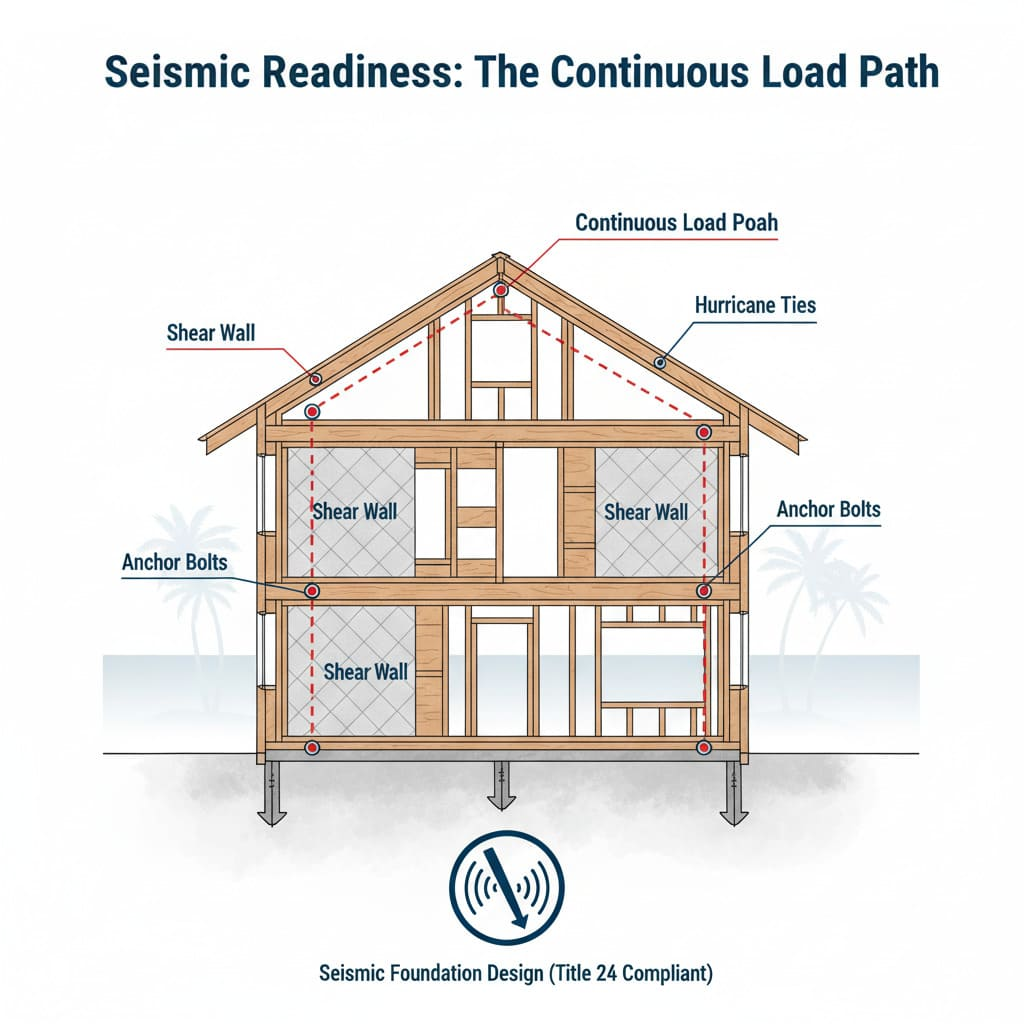
1. The Continuous Load Path: A Seatbelt for Your House
This is the single most important concept in seismic design. A continuous load path is an unbroken chain of connections that ties your entire home together, from the roof to the foundation, and locks it to the ground.
- Roof-to-Walls Special connectors (like “hurricane ties”) ensure your roof doesn’t separate from the walls.
- Walls-to-Floor The walls are mechanically strapped to the floor systems.
- Floor-to-Foundation The “mudsill” (the first piece of wood on the concrete) is bolted to the foundation with heavy-duty anchor bolts at precise intervals.
2. Shear Walls: The Unsung Hero
When the ground moves, a house wants to rack and “parallelogram”—turning your strong, square walls into a collapsed rhombus.
To prevent this, Title 24 requires shear walls. These are strategically placed, incredibly strong wall sections built with specific “shear-rated” plywood or OSB, nailed in a precise pattern (e.g., “6-inch on-center”). This creates a rigid box that resists those powerful side-to-side forces.
3. The Foundation: The Anchor of It All
This is where all that seismic force gets transferred into the ground. Title 24, combined with a geological survey, dictates exactly what kind of foundation your home needs.
- Slab-on-Grade For stable soil, it specifies the thickness of the slab and spacing of rebar.
- Post-Tension Slabs In areas with soil movement, it may require an engineered post-tension slab to keep the foundation from cracking.
- Deep Piles In high-liquefaction zones, it will mandate deep pile foundations that anchor the home to stable bedrock far below the unstable soil.
Why a “Licensed” Contractor is Non-Negotiable
You can’t “buy” Title 24 compliance at a store. It can only be built by a team that understands the engineering behind the code.
- We Understand the Code We are trained, tested, and held accountable to these standards. We know the nailing schedules, the hardware requirements, and the engineering principles.
- We Manage Inspections Your project will have multiple inspections (foundation, framing, etc.). We know what the Newport Beach inspectors are looking for because we share the same goal: a safe, compliant structure.
- We Protect Your Investment A “handshake deal” with an unlicensed builder to “save money” is the most expensive gamble you can take. If the work isn’t compliant, you’ll be forced to tear it out. If the home fails, you have no recourse.
Your home is a complete system. The seismic principles that hold your house together are the same ones we apply to your custom luxury deck and your interlocking paver patio. It all has to be built to last.
This level of integrated expertise is the standard at Gaga US Construction. We are the Newport Beach contractor recognized for proven results and an unwavering commitment to structural integrity.
Don’t Guess if Your Home is Safe. Know. Contact Gaga US Construction today for a professional consultation.
Frequently Asked Questions
Let's Build Something Lasting
Stop searching and start building. If you are ready to secure your home and boost your curb appeal, let’s talk. We are currently booking for the 2026 season.