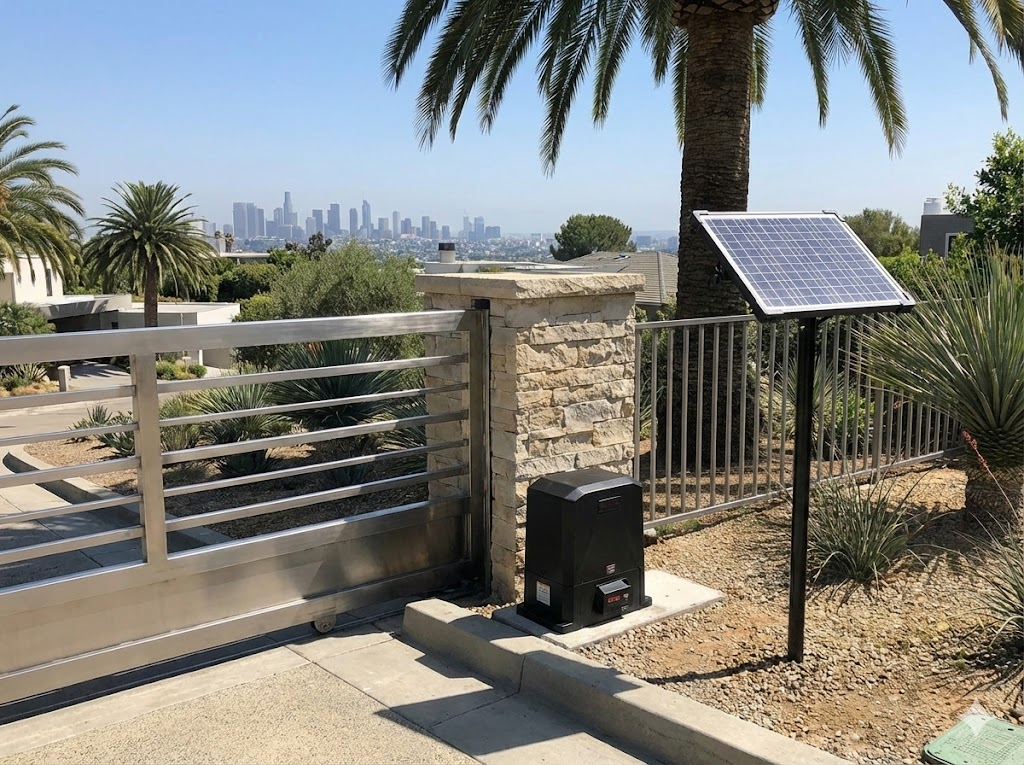
For homeowners in Los Angeles, the driveway gate is more than just an entryway; it is the first line of defense in a city that values privacy and security. However, traditional electric gates have always come with a heavy "hidden" price tag: the cost of trenching high-voltage power lines through sixty feet of concrete or asphalt.
This financial hurdle has driven a massive shift toward solar gate systems. Once seen as a niche solution for rural ranches, these off-grid systems are now the standard for properties from Porter Ranch to Pacific Palisades. But installing solar in an urban environment like L.A. requires more than just pointing a panel at the sky. You have to navigate the infamous "June Gloom," strict Fire Department access codes, and specific zoning regulations.
This guide provides a comprehensive look at solar gate systems, tailored specifically for the Los Angeles climate and regulatory environment. We will strip away the jargon and look at the engineering and economics that make these systems viable.
1. The Economic Case: Trenching vs. Solar
The primary driver for choosing solar gate systems over hardwired electric openers is rarely about "going green"—it is about saving money on construction. If you have an existing driveway, trenching through hardscape costs between $15 and $40 per linear foot. For a typical 100-foot run, the trenching alone can cost $1,500 to $3,000.
By contrast, solar gate systems generate their own power right at the pillar. The federal government also sweetens the deal. Under the Residential Clean Energy Credit, you can claim a 30% tax credit on the cost of the solar electric property (panels, batteries, and wiring) installed at your residence through 2032.
2. Battling "June Gloom": Designing for Reliability
A common misconception is that solar gate systems work perfectly in Los Angeles because "it's always sunny." Local installers know better. The coastal marine layer can reduce solar output by 75% for weeks at a time.
- The 30-Watt Standard Most DIY kits come with a tiny 5-10 watt panel. For reliability in L.A., especially with keypads or sensors, you should upgrade to a 30-watt panel to capture enough diffuse light on overcast days.
- Battery Chemistry Matters In the San Fernando Valley heat, standard lead-acid batteries degrade quickly. We are seeing a shift toward LiFePO4 (Lithium Iron Phosphate) batteries. Unlike lead-acid, these can be safely discharged up to 90%, effectively doubling your "fuel tank" for gloomy weeks.
- Winter Tilt In December, panels mounted flat on a pilaster will lose significant power. Panels must be angled south, ideally at about 49 degrees (Latitude + 15°) to catch the low winter sun.
3. Navigating LAFD and Regulations
Los Angeles has some of the strictest access control laws in the country. When you install solar gate systems, you are dealing with emergency access.
The LAFD "20-Foot Rule" & Knox Box
The Los Angeles Fire Department (LAFD) requires that any gate across a fire access road provides a minimum clear opening width of 20 feet. Furthermore, you must install a Knox Key Switch (Model 3502). This allows fire crews to override your motor. For solar gates, if the battery dies, the gate must also have a "fail-safe" manual release.
Permit Exemptions: The good news is that LADBS generally exempts low-voltage electrical work (under 50 volts) from standard electrical permits, allowing you to skip the expensive permitting process required for hardwired gates.
4. Smart Home Integration and "Phantom Load"
Modern homeowners want smartphone control, but Wi-Fi chips use significant power ("phantom load"), draining a standard solar battery in days.
To solve this, leading brands use low-power workarounds. LiftMaster myQ uses a low-energy radio signal to talk to a "bridge" device inside the house, saving the gate's battery. Ghost Controls utilizes "ZombieCode" technology to keep the system in a deep sleep until a button is pressed.
5. Top Brands for Los Angeles
Based on reliability in high-heat and coastal environments, three manufacturers stand out for solar gate systems in Southern California.
The workhorse of the industry. Linear actuator optimized for solar (zero standby current). Natively integrates with myQ smart home tech.
Designed from the ground up for solar. Lifetime warranty on motor/gears. "ZombieLock" secures the gate against Santa Ana winds.
Commercial-grade DC motors (like the X-390) for heavy wrought-iron estate gates. Requires custom 40W+ solar setups.
6. Maintenance Checklist
Solar gate systems are low maintenance, not no maintenance. To avoid getting locked out, perform these checks twice a year:
- Clean the Panel A layer of LA smog or dust can drop efficiency by 15%. Wipe it down regularly.
- Check for Shadows A branch shading just 10% of your panel can shut down the entire system. Trim back vegetation aggressively.
- Insect Prevention Ants love the warmth of control boxes. Place specialized insect repellent inside the housing to prevent short circuits.
Conclusion
The transition to solar gate systems in Los Angeles is driven by practical necessity. They solve the problem of powering perimeter security without tearing up your driveway, and they offer immunity from grid power outages.
By understanding the local solar limitations—over-sizing your panels for the marine layer and choosing the right battery chemistry for the heat—you can build an access system that is both secure and sustainable. In the world of solar access, efficiency is the ultimate luxury.