Home » Fence Material Showdown: Wood vs. Vinyl vs. Composite Fencing | 2026 Los Angeles Comparison
Get Your Free Estimate
Fill out the form below. We reply within 24 hours.
ON THIS PAGE
- Fence Installation
Fence Material Showdown: Wood vs. Vinyl vs. Composite Fencing | 2026 Los Angeles Comparison
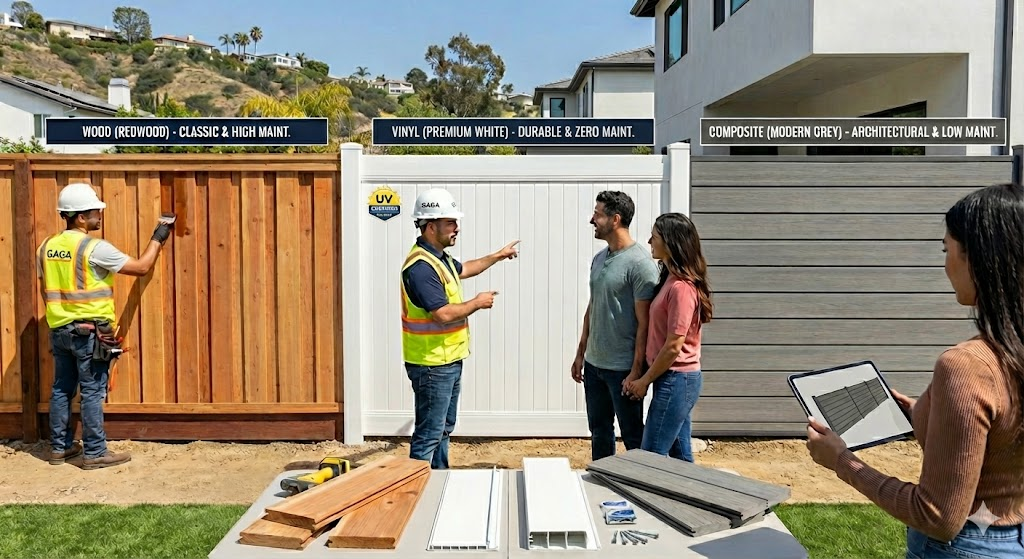
The residential infrastructure landscape of Los Angeles County has undergone a radical transformation as of 2026. Fencing, once a secondary consideration in property management, has elevated to a primary capital expenditure decision for homeowners. This evolution is driven by a convergence of legislative mandates, material science, and the shifting micro-climates of Southern California. This article serves as a definitive comparative analysis of Wood, Vinyl (PVC), and Composite fencing, tailored specifically to the regulatory and environmental exigencies of the Los Angeles market.
1. Executive Intelligence: The LA Paradigm
In 2026, the decision matrix for fencing is dominated by Assembly Bill 3074 and associated "Zone 0" defensible space regulations. These mandates have effectively outlawed combustible fencing materials attached to structures in fire-prone zones. Simultaneously, the industry has witnessed a surge in material innovation, such as "cool-touch" composites and UV-stabilized vinyls designed for the San Fernando and San Gabriel Valleys.
The economic landscape has also shifted. With fence installation labor rates in LA stabilizing between $40 and $90 per hour, the Total Cost of Ownership (TCO) calculation has supplanted "initial bid price" as the primary metric for savvy homeowners.
1.1 The Micro-Climate Challenge
- The Coastal Zone (Santa Monica to Long Beach): The adversary is marine corrosion. The daily "marine layer" cycle causes rapid expansion and contraction in wood (hygroscopic cycling), leading to warping and dry rot. Vinyl and closed-cell composites excel here due to their hydrophobicity.
- The Inland Valleys: The challenge is intense thermal load. Surface temperatures on dark materials can exceed 150°F. Standard vinyl risks heat deflection (softening) if not engineered with high heat distortion temperatures (HDT).
- The Fire Corridors (Malibu, Topanga, Foothills): Subject to strict Wildland-Urban Interface (WUI) codes, material choice here is a legal mandate, not a preference.
2. Material Science and Engineering
2.1 Wood: Cellular Structure and Treatment
Wood is a biological material programmed to decompose. It is hygroscopic; its cell walls absorb and release moisture to reach equilibrium with the atmosphere. In LA, where relative humidity swings drastically between Santa Ana winds and coastal fog, wood undergoes constant dimensional stress. This results in the twisting and splitting seen in pressure-treated pine.
To combat the aggressive subterranean termite population in LA, softwood lumber is impregnated with Copper Azole (CA-C) or ACQ. While effective against rot, these chemicals are corrosive to standard fasteners, requiring stainless steel hardware. For naturally resistant species like Redwood, the distinction between "Heartwood" (dense, tannin-rich) and "Sapwood" (living outer wood) is critical. In 2026, much of the Redwood sold is sapwood-heavy, requiring immediate chemical sealing to survive.
2.2 Vinyl (PVC): Co-Extrusion and UV Stabilization
Vinyl fencing is a co-extruded thermoplastic. It consists of two layers:
- The Substrate (Inner): Engineered for impact resistance with acrylic modifiers to prevent shattering.
- The Capstock (Outer): The shield. The concentration of Titanium Dioxide (TiO2) here is the determinant of quality. TiO2 acts as a sunblock. Premium vinyl contains at least 10 parts per 100 of TiO2. Economy lines use chalk fillers, leading to rapid "chalking" and yellowing.
Standard PVC has an HDT of 140°F-160°F. Dark-colored vinyl surfaces in LA can easily exceed this, which is why reliable vinyl is restricted to lighter colors (White, Tan, Grey) to maintain dimensional stability.
2.3 Composite: The Polymer-Fiber Matrix
Composite is a Wood-Plastic Composite (WPC). Modern premium composites utilize a polymer "cap" that wraps the board to prevent moisture absorption and mold. Because they are dense, they have high thermal mass, retaining heat longer than wood or vinyl. Manufacturers like TimberTech have introduced "Advanced PVC" lines that remove wood flour entirely, allowing the product to cool faster and remain impervious to moisture.
3. The Contender: Wood Fencing Analysis
Prized for organic variation and "craftsman" quality, wood is shifting from a low-cost commodity to a high-maintenance luxury.
3.1 Installation Costs and Maintenance
In 2026, wood installation ranges from $20 to $50 per linear foot. Pressure-Treated Pine is entry-level ($15-$30), Cedar is mid-range ($25-$45), and "Con Heart" Redwood is premium ($30-$50+). Labor is intensive because these are often "stick-built" on-site to handle LA's hilly topography.
The Maintenance Burden: Wood fibers undergo photo-oxidation rapidly. A UV-inhibiting stain must be applied every 2-3 years at a cost of $3-$8 per linear foot. Over 15 years, a homeowner might spend $3,000-$5,000 on maintenance—effectively repurchasing the fence.
4. The Contender: Vinyl (PVC) Fencing Analysis
Vinyl is the pragmatic champion for LA’s flatland neighborhoods. It is installed as pre-fabricated panels, significantly reducing on-site labor time compared to stick-built wood.
4.1 Performance in LA Heat and Soil
Professional-grade vinyl uses thicker wall profiles (0.135") to prevent the "oil can" rippling effect. Because LA soil ranges from expansive clay to sandy loam, professional installation requires post holes 24-30 inches deep—below the active soil expansion zone. In high-wind corridors (Fontana, Sylmar), we use Aluminum H-Channel stiffeners inside the posts to prevent snapping during 70mph Santa Ana gusts.
5. The Contender: Composite Fencing Analysis
Composite is the luxury choice for modern architectural renovations in Silver Lake, Venice, and West Hollywood. It is the primary enabler of the horizontal fence trend.
5.1 The Horizontal Shift
Horizontal wood fences are notorious for "gravity bow"—warping under their own weight. Composite boards are extruded to be perfectly straight and dimensionally stable. While expensive, the clean, gap-free lines complement Mid-Century Modern and Contemporary architecture, serving as a design element that adds significant property value.
6. Regulatory and Compliance Landscape
6.1 Zone 0 and AB 3074
The "Zone 0" mandate requires that the first 5 feet of fencing attached to a structure in Very High Fire Hazard Severity Zones (VHFHSZ) be non-combustible. Wood and vinyl fences cannot connect directly to the house. Homeowners must install a "fuel break" (Metal or Masonry) for the first 5 feet. Failure to comply can result in insurance non-renewal.
6.2 Permit Fees and Disposal
LADBS height variance fees are substantial—over $5,400 for a Zoning Administrator determination. Additionally, disposing of old fences is costly. Treated Wood Waste (TWW) is considered hazardous waste in California. It cannot go in standard bins and incurs a "Hard-to-Handle" surcharge, adding $4-$6 per linear foot to removal costs.
7. Financial Analysis: 10-Year TCO Matrix
Calculated per 100 linear feet. This matrix highlights the transition from initial bid to long-term cost.
| Cost Category | PT Wood (Low End) | Premium Vinyl | Composite (Mid) |
|---|---|---|---|
| Initial Install (Avg) | $2,500 | $3,500 | $5,500 |
| Permit Fees | $200 | $200 | $200 |
| Maint. Year 3 (Stain/Wash) | $450 | $0 | $0 |
| Maint. Year 6 (Stain/Wash) | $500 | $0 | $0 |
| Maint. Year 9 (Stain/Wash) | $550 | $0 | $0 |
| Repairs (Termite/Impact) | $300 | $100 | $50 |
| 10-Year Total (TCO) | $4,500 | $3,800 | $5,750 |
8. Strategic Recommendations for 2026
- Compliance-First (Foothills): Use a Metal/Composite hybrid. Class A fire resistance is the priority. Avoid wood to prevent insurance audits.
- Value-Driven (Suburban Valleys): Premium Vinyl is the winner. The highest UV stability and lowest TCO for families planning to stay 10+ years.
- Aesthetic-Driven (Urban Core): Horizontal Composite. The visual expansion adds value to small lots. Ensure "cool touch" technology is selected for dark tones.
Frequently Asked Questions
Can I install a new Vinyl or Composite fence over my existing wood posts to save on labor?
How does the "Zone 0" fire regulation affect my existing landscaping and irrigation near the fence?
Under the 2026 compliance framework, the 0-5 foot “Ember-Resistant Zone” applies to more than just the fence. If you are installing a non-combustible metal or hybrid fence panel to meet the law, you must also ensure that the ground cover below it is non-combustible (such as gravel, pavers, or decorative rock). We often need to cap or reroute existing irrigation lines that fed mulch-heavy garden beds in that 5-foot zone to prevent water damage to the new non-combustible “fuel break” structures.
Does the extreme Los Angeles "Hard Water" affect the appearance of darker Vinyl or Composite fences?
Yes. If your property uses a sprinkler system with LA’s typically “hard” municipal water, the mineral deposits (calcium and magnesium) can leave white, cloudy spotting on dark grey or brown composite and vinyl. While this doesn’t damage the structural integrity, it can diminish the aesthetic. We recommend adjusting sprinkler heads to avoid direct contact with the fence or installing a water softener for your outdoor lines if you choose a premium dark-toned material.
If my neighbor refuses to pay their half under the "Good Neighbor Fence Act," what is my immediate recourse?
While California Civil Code 841 creates a legal presumption of shared responsibility, it does not allow you to force a neighbor to pay upfront before construction. If a neighbor refuses to contribute after receiving the mandatory 30-day written notice, you may have to pay for the project in full and then seek reimbursement through Small Claims Court. We recommend keeping all photos of the previous fence’s “blight” or “hazard” status, as this serves as evidence that the replacement was a necessary “reasonable” repair rather than just a cosmetic upgrade.
Let's Build Something Lasting
Stop searching and start building. If you are ready to secure your home and boost your curb appeal, let’s talk. We are currently booking for the 2026 season.