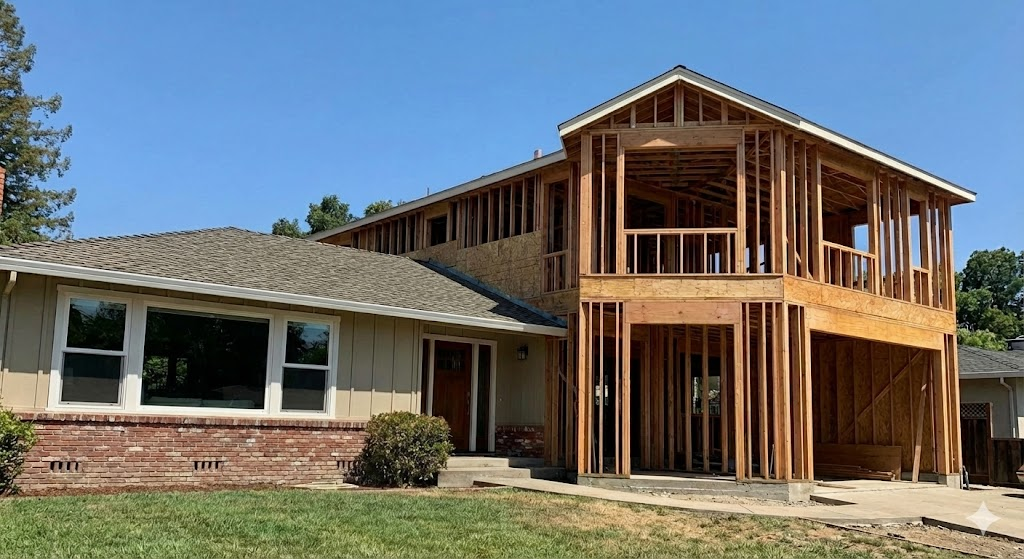
There is a distinct reason people move to Moraga. It is the silence of the hills, the safety of the cul-de-sacs, and the feeling of being away from the chaos while still being connected to the Bay. But let’s be honest: many of the homes here were built in a different era. They are classic Ranches with good bones, but they often lack the flow, the light, and the modern amenities that families expect in 2025.
If you are reading this, you are likely planning home additions in Moraga. Maybe you need a primary suite that actually fits a king-sized bed, or you want to open up that dark 1970s kitchen to the backyard view. But building here is not like building in Los Angeles or even Walnut Creek. It requires a different strategy.
At GAGA US Construction, we have navigated these hills enough to know that success here isn't just about pouring concrete—it’s about understanding the land and the strict local "character" codes. Here is the honest truth about expanding your home in Moraga.
The Moraga Challenge: It’s Not Just Math, It’s Art
In most cities, if you own the land and follow the setback rules, you get your permit. Moraga is different. The town protects its "semi-rural character" fiercely. The Design Review Board (DRB) doesn't just check our math; they check our aesthetics.
We see projects get rejected constantly because they try to force a "McMansion" box onto a scenic hillside. The goal for successful home additions in Moraga is "invisible density." We need to add square footage in a way that feels like it has always been there.
Why We Avoid Second Stories
While technically allowed, second-story additions are a magnet for neighbor complaints and view-blockage hearings. They trigger intense scrutiny.
Instead, we are seeing a massive shift toward volume. We strip the ceilings of single-story homes to the rafters, creating vaulted "Great Rooms" with 14-foot peaks. You get the luxury of space and light without triggering a war with the neighborhood over ridgeline heights.
The "New California Classic" Design
The trend for 2025 has moved away from the sterile, hospital-white minimalism of the last decade. Homeowners here want warmth. We call it "Warm Minimalism."
- Natural Materials We are ripping out grey laminate and installing white oak floors, limestone, and unlacquered brass. Materials that patina and age gracefully.
- The Indoor-Outdoor Blur A sliding glass door isn't enough anymore. We are installing 20-foot panoramic folding glass walls that physically remove the barrier between your living room and the patio.
- Fire Hardening is the New Luxury In Moraga, you are in the Wildland-Urban Interface (WUI). We don't just use fire-resistant materials because the code says so; we use them because they are better. Fiber cement siding and ember-resistant vents are now standard features that actually boost resale value.
The "Invisible" Addition: ADUs and JADUs
If you are dreading the design review process for a major addition, there is a smarter play: The Accessory Dwelling Unit (ADU).
Thanks to state laws, ADUs have a streamlined approval path that bypasses a lot of the subjective review. In Moraga’s hillside homes, we often find massive, under-utilized crawlspaces or basements. We can convert these into "Junior ADUs" (JADUs). This adds up to 500 square feet of high-value living space without changing the exterior footprint of your home. It is the most efficient way to add value right now.
Our Process for Hillside Additions
Building on a slope requires engineering precision. You cannot just dig a hole and hope for the best. Here is how GAGA US Construction manages complex home additions in Moraga.
Real Talk on Costs and ROI
I believe in transparency. Construction in the Bay Area is expensive, and Moraga’s hillside terrain adds a "complexity premium." You need to budget for the stuff you don't see—the engineering, the grading, and the retaining walls.
However, the ROI is distinct here. While a $100,000 kitchen appliance package is a lifestyle choice that you might not earn back, investments in square footage and fire safety pay dividends. A home that is verified as "fire-hardened" with modern, defensible space landscaping is a unicorn in this market, and buyers will pay a premium for that peace of mind.
Ready to Build Your Legacy?
Your home in Moraga is more than just an asset; it is where your life happens. Don't trust it to a contractor who treats it like a generic tract home. You need a partner who understands the soil, the codes, and the unique beauty of this town.
At GAGA US Construction, we build additions that look like they were always meant to be there. Let's create something lasting.