The LA Backyard Shift: Why "Open" Is the New Private
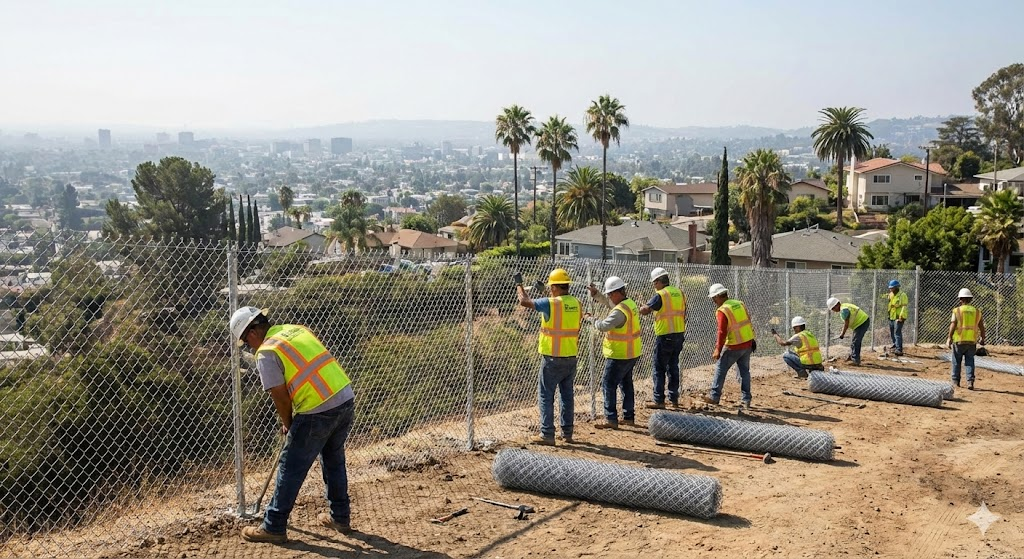
If you drive through neighborhoods like Mar Vista, Studio City, or the Hollywood Hills in 2025, you'll notice the walls are coming down—or at least, they're becoming transparent. The old fortress-style solid fences are being replaced. Los Angeles homeowners are trading opacity for "borrowed views" and airflow. The wire mesh fence—specifically black welded grids framed in rich California wood—has become the defining feature of the modern LA home.
This isn't just about the "Modern Farmhouse" look, though that plays a huge part. It's about practical survival in Southern California. We need fences that let the cool evening breeze through, fences that don't act as fire wicks in a canyon wildfire, and fences that keep urban coyotes out without making our yards feel like prison yards.
Whether you call it "hog wire," "cattle panel," or "California chain link," this guide breaks down exactly what you need to know to upgrade your property line. And when you're ready to build, you need a team that knows the local terrain. GAGA US Construction specializes in bringing these custom hardscapes to life across Los Angeles—if you can dream it, they can build it.
1. The Look: It's Not Just "Chicken Wire"
Let's clear up the confusion. When designers talk about "wire mesh fencing," they aren't talking about flimsy poultry netting. They are talking about heavy-duty, architectural-grade steel.
The "Hog Wire" Standard
The most popular look right now is the Rigid Panel. These are heavy-gauge steel mats (usually 4-gauge or 6-gauge) welded into uniform 4x4-inch squares. Unlike rolled wire that gets wavy and saggy over time, these panels stay flat and stiff.
The Black Magic
You want black. Always. Silver galvanized wire reflects the harsh LA sun and creates glare. Black absorbs the light, effectively "disappearing" so your eye focuses on the view beyond the fence—whether that's your pool or the Santa Monica Mountains.
Dip-Coated vs. Powder Coated
In our salty coastal air, standard powder coating can chip and rust. For high-end homes, ask for fluidized bed dip-coating. It’s a thick, rubberized vinyl skin that seals the steel completely. It’s the difference between a fence that lasts 5 years and one that lasts 40.
The "California Style" Chain Link
Don't roll your eyes at chain link. The "California Style" (or "Wood-Framed Chain Link") is having a massive comeback in 2025. By taking high-quality black vinyl-coated chain link and framing it with premium cedar or redwood rails, you get a sleek, modern-industrial look for a fraction of the cost of rigid panels. It’s perfect for large perimeters in the Valley or hidden dog runs.
2. The Skeleton: Redwood vs. Cedar in SoCal
The metal is the star, but the wood frame is the muscle. In Los Angeles, you really only have two serious contenders.
California Redwood (The Local Hero)
Redwood is the gold standard here. It contains natural tannins that make it distasteful to termites and resistant to rot without any chemical injection.
Why choose it: It’s dimensionally stable. It won’t twist or warp in our dry Santa Ana heatwaves, which is crucial for keeping your wire panels tight.
The catch: It's getting pricier and harder to find "Con-Heart" (Construction Heart) grade, which is the only grade you should let touch the ground.
Western Red Cedar (The Northern Contender)
Imported from the Pacific Northwest, Cedar is the primary alternative. It smells great and resists rot, but it’s softer than old-growth redwood.
Why choose it: It weathers to a beautiful silvery-gray that fits the coastal "beach shack" aesthetic perfectly. It's often more affordable for the rails and top caps.
The Verdict: If you can afford it, go with Redwood posts for ground contact and Cedar for the rails. Or, skip the wood rot entirely and ask GAGA US Construction about PostMaster steel posts—they can be hidden inside wood faces so you get the look of timber with the strength of steel.
3. The Rules: Navigating LA’s Red Tape
Before you dig a single post hole, you need to know the Los Angeles Municipal Code (LAMC). The city inspectors are strict, especially regarding visibility.
The 42-Inch Rule
In your front yard, your fence generally cannot be taller than 42 inches (3.5 feet). This keeps neighborhoods feeling open. However, because wire mesh is transparent, you can sometimes get away with more creative designs than you could with a solid block wall—but check with the city first.
The Visibility Triangle
If you live on a corner lot, you have a "visibility triangle" at the intersection where nothing can block a driver's view. Wire mesh is often a lifesaver here because it’s "open," but you still need to verify your specific zoning.
HPOZ (Historic Zones)
Do you live in an HPOZ like Highland Park or Hancock Park? You can't just put up whatever you want. The historic board will review your fence. Wire mesh is often accepted as "neutral," but you need a pro to navigate the paperwork.
4. Hardening Your Home: Fire & Coyotes
In LA, your fence is your first line of defense.
Fire Safety in the Hills
If you are in a "Very High Fire Hazard Severity Zone" (which is most of the hills and canyons), a solid wood fence is basically a fuse leading to your house.
The Mesh Advantage: Wire mesh doesn't burn. It also lets embers blow through the fence rather than piling up against it.
Metal Posts: We strongly recommend steel posts instead of wood for canyon homes. It creates a non-combustible barrier that insurance companies love.
The Coyote Problem
Coyotes can jump 6-foot fences.
The Fix: Use a 2x2 inch mesh grid instead of the standard 4x4. Coyotes can't get their paws in the smaller holes to climb.
Coyote Rollers: These are spinning bars you install on top of the fence. When a coyote tries to pull themselves over, the bar spins and they fall off. They integrate perfectly with flat-top hog wire fences.
5. Maintenance: Fighting the Smog
Even the best black vinyl coating can get a layer of LA smog and traffic film over time.
The Wash
Once a year, mix some mild dish soap with warm water and hose down your fence.
No Bleach
Never use bleach on black vinyl—it will turn it a chalky gray.
Graffiti
If your fence gets tagged, use a specialized remover like "Sensitive Surface Graffiti Remover" immediately. Don't use acetone; it will melt the vinyl coating.
Ready to Upgrade?
A wire mesh fence transforms your property from "enclosed" to "expansive." It creates a secure boundary that feels open, modern, and high-value. But precision framing and code compliance are not DIY-friendly for most people.